L.S. Smith and Associates
  • HOME
  • ABOUT
    • ABOUT
    • CAREER OPPORTUNITIES
    • SUPPLIERS
    • PRIVACY & TERMS OF USE
  • SERVICES
    • LIFE STAGES
      • FINANCIAL ADVICE
      • STARTING YOUR CAREER
      • GROWING FAMILIES
      • MATURING FAMILIES
      • PREPARING FOR RETIREMENT
      • RETIREES
      • ESTATE PLANNING
    • BUSINESS
      • FINANCIAL ADVICE FOR BUSINESS OWNERS
      • BUSINESS CONTINUATION
      • BUSINESS SUCCESSION
      • EXECUTIVE BENEFITS
    • EMPLOYEE BENEFITS
    • INSURANCE PLANNING
      • LIFE INSURANCE
      • MORTGAGE INSURANCE
      • CRITICAL ILLNESS INSURANCE
    • RETIREMENT PLANNING
      • TAX FREE SAVINGS ACCOUNT
      • REGISTERED EDUCATION SAVINGS PLAN
      • REGISTERED RETIREMENT SAVINGS PLAN
      • REGISTERED RETIREMENT INCOME FUND
    • BANKING SERVICES
    • TAX SERVICES
    • LIBERTY TAX SERVICES
  • RESOURCES
    • INVESTOR LOGIN
    • RESOURCES
    • CALCULATORS
  • BLOG
  • CONTACT
  • Click to open the search input field Click to open the search input field Search
  • Menu Menu

    Tax-Free Savings Account vs Registered Retirement Savings Plan

    February 2, 2026/in 2026, Blog, Investment, rrsp, Tax Free Savings Account/by LS Smith & Associates

    Tax-Free Savings Account vs Registered Retirement Savings Plan

    When it comes to saving in a tax-efficient way, Canadians often ask the same question: Should I use a TFSA or an RRSP?

    Both accounts offer valuable tax advantages, but they work differently — and the “right” choice depends on your income, goals, and how you expect to use the money in the future. As advisors, we often help clients understand not just how these accounts work, but how to use them strategically together.

    Below, we break down the key differences between TFSAs and RRSPs, focusing on how contributions and withdrawals work — and how those differences can shape your overall plan.

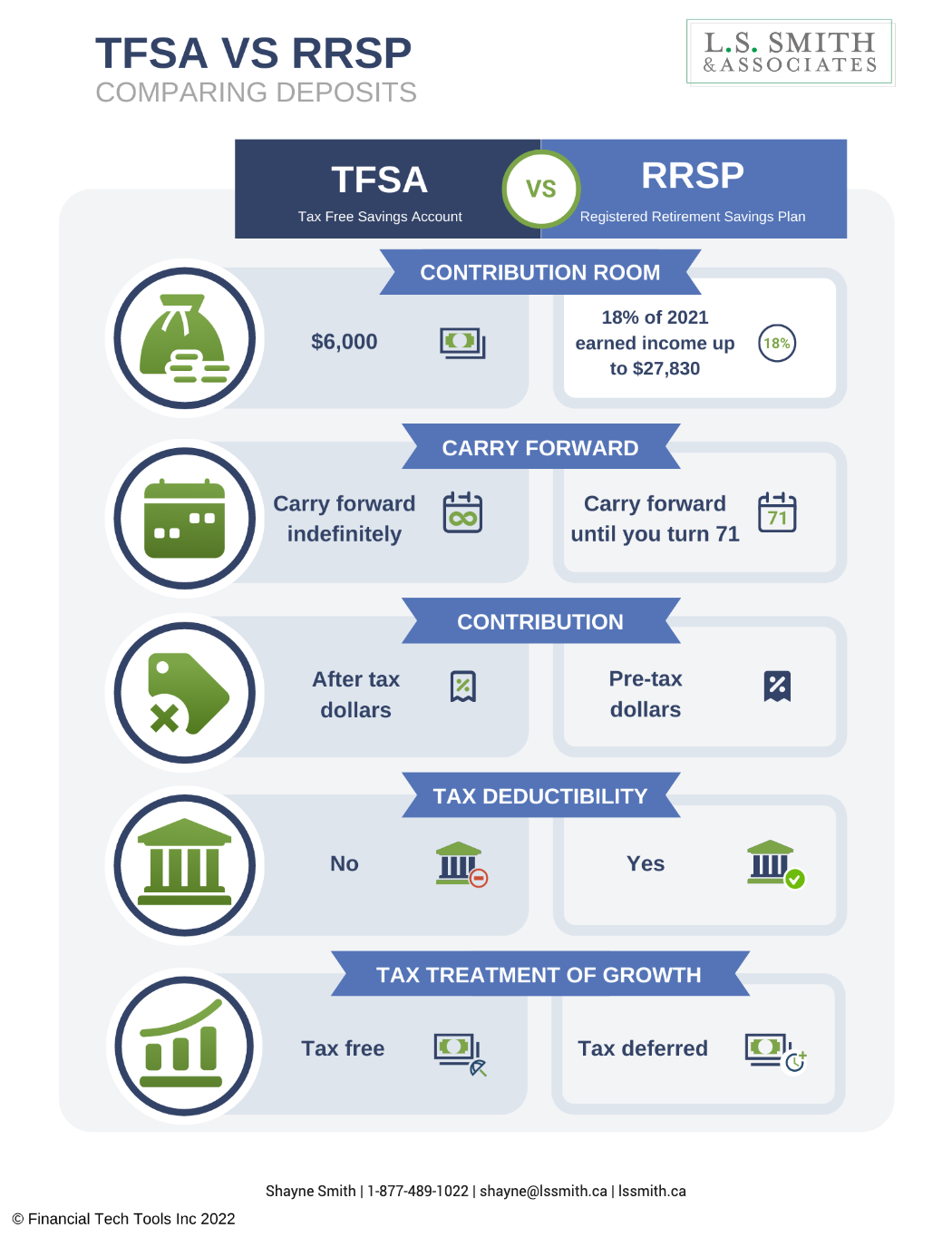
    TFSA vs RRSP: Differences in Contributions

    When comparing how TFSAs and RRSPs work on the contribution side, there are four main factors we look at with clients:

    • Contribution room
    • Carry forward rules
    • Tax deductibility
    • Tax treatment of growth
    brandableContent

    How much contribution room do you have?

    TFSA

    Your TFSA contribution room is based on an annual limit set by the federal government, which is indexed and may change over time. If you don’t use your full TFSA room in a given year, the unused amount carries forward and continues to accumulate as long as you’re eligible.

    This makes the TFSA especially flexible for people who contribute irregularly or who want to prioritize liquidity.

    RRSP

    RRSP contribution room is based on your income. Each year, you can contribute up to 18% of your earned income from the prior year, up to an annual maximum set by the Canada Revenue Agency.

    Because RRSP room depends on income, contribution limits will naturally vary from person to person.

    Can unused contribution room be carried forward?

    Yes — for both accounts, but with different rules.

    TFSA

    Unused TFSA contribution room can be carried forward indefinitely. If you make a withdrawal, the amount withdrawn is added back to your available contribution room in the following calendar year.

    RRSP

    Unused RRSP contribution room can also be carried forward, but only until the year you turn 71. At that point, your RRSP must be converted to a Registered Retirement Income Fund (RRIF) or another qualifying option. Withdrawals from an RRSP do not create new contribution room.

    Are contributions tax-deductible?

    This is one of the most important distinctions.

    • TFSA contributions are made with after-tax dollars and are not tax-deductible.
    • RRSP contributions are made with pre-tax dollars and are tax-deductible, which can reduce your taxable income in the year you contribute.

    How is investment growth taxed?

    • TFSA growth is completely tax-free. You don’t pay tax on interest, dividends, capital gains, or withdrawals.
    • RRSP growth is tax-deferred. Investments can grow without tax while they remain inside the plan, but withdrawals are taxable when taken.

    This difference plays a major role in how each account is used within a broader financial strategy.

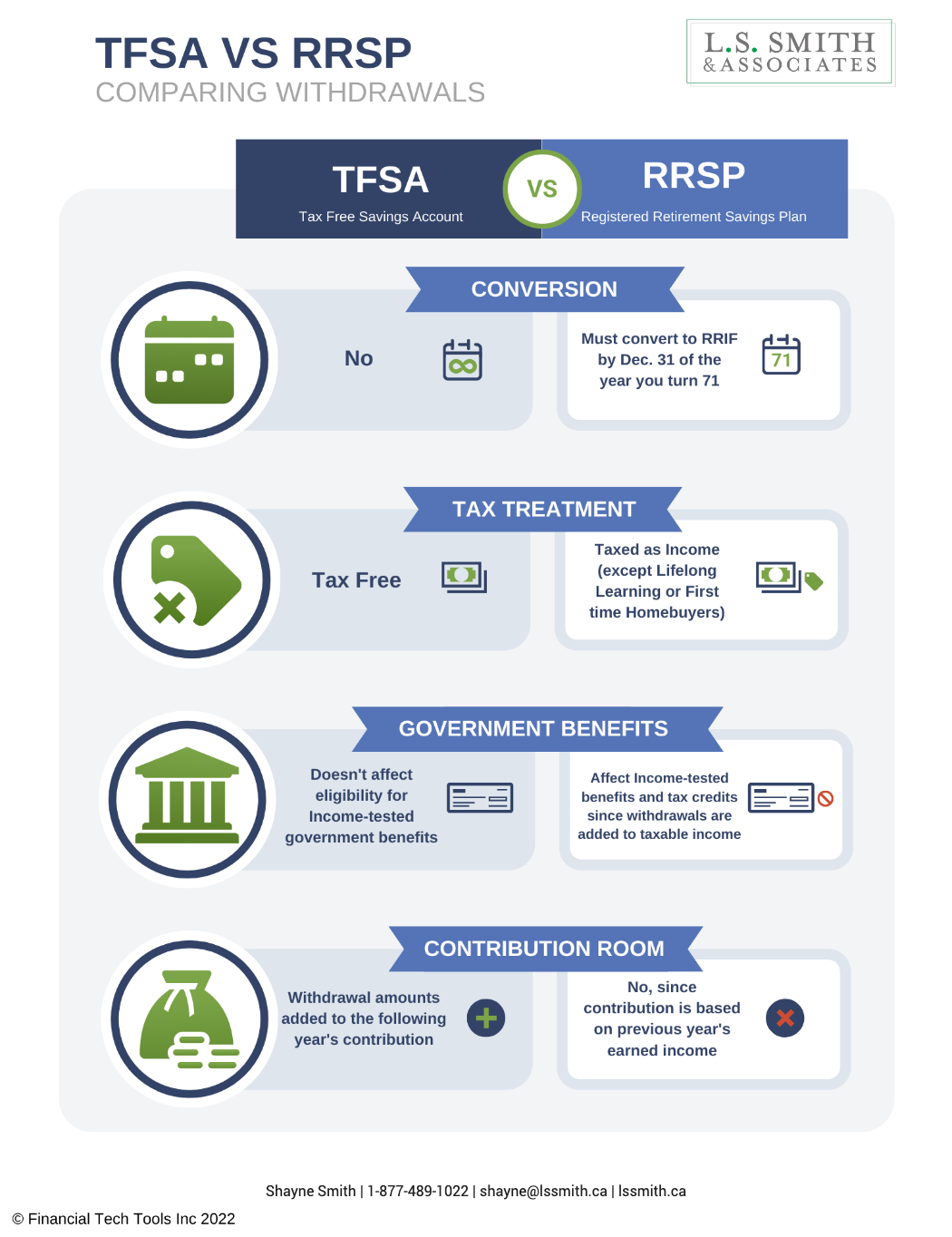
    TFSA vs RRSP: Differences in Withdrawals

    Understanding how withdrawals work is just as important as understanding contributions. When we help clients evaluate withdrawals, we focus on:

    • Conversion requirements
    • Tax treatment
    • Impact on government benefits
    • Effect on future contribution room
    brandableContent

    Are there conversion requirements?

    TFSA

    There are no conversion requirements for a TFSA. You can hold and use a TFSA at any age.

    RRSP

    An RRSP must be converted to a RRIF (or similar option) by December 31 of the year you turn 71. After conversion, minimum annual withdrawals are required.

    How are withdrawals taxed?

    TFSA

    All TFSA withdrawals are tax-free, regardless of when or why the money is withdrawn.

    RRSP

    RRSP withdrawals are taxed as income in the year they’re taken.

    There are two commonly used programs that allow temporary RRSP withdrawals:

    • The Home Buyers’ Plan (HBP)
    • The Lifelong Learning Plan (LLP)

    Withdrawals under these programs are not taxed at the time of withdrawal, provided they are repaid according to the program rules. If they are not repaid, the amounts become taxable income.

    How do withdrawals affect government benefits?

    This is an area we pay close attention to when planning withdrawals.

    • TFSA withdrawals do not count as taxable income and generally do not affect income-tested government benefits.
    • RRSP (and RRIF) withdrawals are taxable and may affect income-tested benefits and tax credits, depending on your total income.

    This distinction often makes TFSAs particularly valuable later in life or during years when benefit eligibility matters.

    Do withdrawals create new contribution room?

    • TFSA: Withdrawals restore contribution room in the following calendar year.
    • RRSP: Withdrawals do not create new contribution room.

    How advisors typically help clients choose

    In practice, the decision isn’t usually TFSA or RRSP — it’s how and when to use each.

    We often consider:

    • Current vs future tax rates
    • Income stability
    • Access to employer pension plans
    • Government benefits today or later
    • Short-term flexibility vs long-term tax deferral

    Used thoughtfully, both accounts can play an important role in a well-structured plan.

    TFSAs and RRSPs are both powerful savings tools, but they’re designed to solve different problems. Understanding how they work — and how they interact with your income, taxes, and benefits — can make a meaningful difference over time.

    If you’d like help determining how a TFSA, RRSP, or a combination of both fits into your overall strategy, we’re happy to walk through your options with you.

    Sources:

    Canada Revenue Agency. Registered Retirement Savings Plan (RRSP). Government of Canada, https://www.canada.ca/en/revenue-agency/services/tax/individuals/topics/rrsps-related-plans/registered-retirement-savings-plan-rrsp.html

    Canada Revenue Agency. Tax-Free Savings Account (TFSA). Government of Canada, https://www.canada.ca/en/revenue-agency/services/tax/individuals/topics/tax-free-savings-account.html

    https://lssmith.ca/wp-content/uploads/2026/02/TFSA-vs-RRSP-FI.png 700 1200 LS Smith & Associates https://lssmith.ca/wp-content/uploads/2018/05/lsSmithLogo.jpg LS Smith & Associates2026-02-02 13:22:322026-02-02 13:22:52Tax-Free Savings Account vs Registered Retirement Savings Plan

    2026 Financial Calendar

    December 31, 2025/in 2026, Blog, Family, Financial Planning, personal finances, rrsp, tax, Tax Free Savings Account/by LS Smith & Associates

    brandableContent
    brandableContent
    brandableContent
    brandableContent
    brandableContent

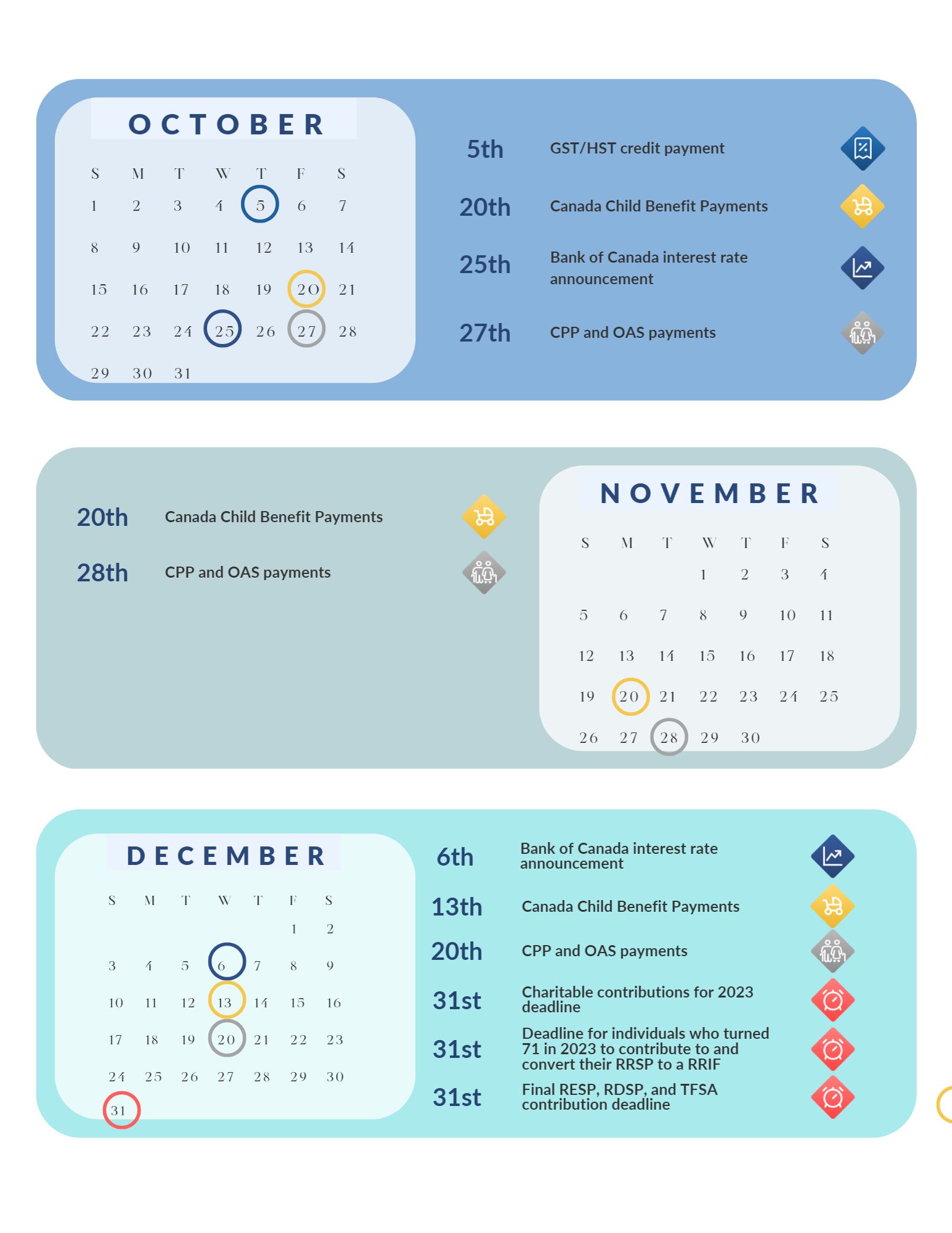
    Welcome to our 2026 financial calendar!

    This calendar is designed to help you keep track of important financial dates and deadlines, such as tax filing and government benefit distribution. You can bookmark this page for easy reference or add these dates to your personal calendar so you don’t miss any important financial obligations.

    If you need help with your taxes, 2025 income tax packages will be available starting January 20, 2026. Don’t wait until the last minute to get started on your tax return – make an appointment with your accountant so you’re ready when tax season arrives.

    Important Dates to Know

    On January 1, 2026, the contribution room for your Tax-Free Savings Account (TFSA) opens again. The TFSA dollar limit for 2026 is $7,000.

    For those who are eligible, the contribution room for your:

    • Registered Retirement Savings Plan (RRSP)

    • First Home Savings Account (FHSA)

    • Registered Education Savings Plan (RESP)

    • Registered Disability Savings Plan (RDSP)

    will also be available for the 2026 calendar year.

    RRSP Deadline (for the 2025 Tax Year)

    For your Registered Retirement Savings Plan (RRSP) contributions to be eligible for the 2025 income tax year, you must make them by:

    • March 2, 2026

    Contributions made after this date will generally count toward your 2026 tax return.

    GST/HST Credit Payment Dates

    GST/HST credit payments will be issued on:

    • January 5

    • April 2

    • July 3

    • October 5

    Canada Child Benefit (CCB) Payment Dates

    Canada Child Benefit payments will be issued on:

    • January 20

    • February 20

    • March 20

    • April 20

    • May 20

    • June 19

    • July 20

    • August 20

    • September 18

    • October 20

    • November 20

    • December 11

    Canada Pension Plan (CPP) and Old Age Security (OAS)

    The government will issue Canada Pension Plan (CPP) and Old Age Security (OAS) payments on the following dates:

    • January 28

    • February 25

    • March 27

    • April 28

    • May 27

    • June 26

    • July 29

    • August 27

    • September 25

    • October 28

    • November 26

    • December 22

    Bank of Canada Interest Rate Announcements

    The Bank of Canada will make interest rate announcements on:

    • January 28

    • March 18

    • April 29

    • June 10

    • July 15

    • September 2

    • October 28

    • December 9

    Personal Income Tax Deadlines

    For most individuals, April 30, 2026 is the last day to:

    • File your 2025 personal income tax return, and

    • Pay any balance owing on your 2025 taxes.

    This is also generally the filing deadline for final returns if death occurred between January 1 and October 31, 2025.

    If death occurred between November 1 and December 31, 2025, the filing deadline for the final return is six months after the date of death (which will fall between May 1 and June 30, 2026).

    Self-Employment Tax Deadlines

    If you or your spouse/common-law partner are self-employed:

    • The filing deadline for your 2025 tax return is June 15, 2026.

    • Any tax payments owing are still due by April 30, 2026.

    Filing later than these dates may result in interest and penalties.

    Year-End Contribution Deadlines

    The final contribution deadline for the 2026 calendar year for the following accounts is December 31, 2026:

    • Tax-Free Savings Account (TFSA)

    • First Home Savings Account (FHSA)

    • Registered Education Savings Plan (RESP)

    • Registered Disability Savings Plan (RDSP)

    December 31, 2026 is also the deadline for:

    • Making 2026 charitable donations that you want to claim on your 2026 tax return.

    Individuals who turn 71 in 2026 to:

    • Make their last contributions to their own RRSPs, and

    • Convert their RRSPs to RRIFs (or an annuity).

    Please reach out if you have any questions or would like help planning around any of these dates.

    Sources:

    Canada Revenue Agency. Tax-Free Savings Account (TFSA), Guide for Individuals. RC4466 (E), Canada.ca, https://www.canada.ca/en/revenue-agency/services/forms-publications/publications/rc4466/tax-free-savings-account-tfsa-guide-individuals.html.

    Canada Revenue Agency. “Registered Retirement Savings Plan (RRSP).” Canada.ca, https://www.canada.ca/en/revenue-agency/services/tax/individuals/topics/rrsps-related-plans/registered-retirement-savings-plan-rrsp.html.

    Canada Revenue Agency. “Registered Education Savings Plans (RESPs).” Canada.ca, https://www.canada.ca/en/revenue-agency/services/tax/individuals/topics/registered-education-savings-plans-resps.html.

    Canada Revenue Agency. “First Home Savings Account (FHSA).” Canada.ca, https://www.canada.ca/en/revenue-agency/services/tax/individuals/topics/first-home-savings-account.html.

    Canada Revenue Agency. “GST/HST Credit – Payment Dates.” Canada.ca, https://www.canada.ca/en/revenue-agency/services/child-family-benefits/gst-hst-credit/payment-dates.html#toc1.

    Canada Revenue Agency. “Benefit Payment Dates.” Canada.ca, https://www.canada.ca/en/revenue-agency/services/child-family-benefits/benefit-payment-dates.html.

    Canada. “Benefit Payment Dates Calendar.” Canada.ca, https://www.canada.ca/en/services/benefits/calendar.html.

    Bank of Canada. “Bank of Canada Publishes 2026 Schedule for Policy Interest Rate Announcements and Other Major Publications.” Bank of Canada, https://www.bankofcanada.ca/2025/08/bank-canada-publishes-2026-schedule-policy-interest-rate-announcements-other-major-publications/.

    Canada Revenue Agency. “Important Dates – Individuals.” Canada.ca, https://www.canada.ca/en/revenue-agency/services/tax/individuals/topics/important-dates-individuals.html.

    Canada Revenue Agency. “Important Dates for RRSPs, RRIFs, and RDSPs.” Canada.ca, https://www.canada.ca/en/revenue-agency/services/tax/individuals/topics/rrsps-related-plans/important-dates-rrsp-rrif-rdsp.html.

    https://lssmith.ca/wp-content/uploads/2025/12/2026-Financial-Calendar-FI.png 700 1200 LS Smith & Associates https://lssmith.ca/wp-content/uploads/2018/05/lsSmithLogo.jpg LS Smith & Associates2025-12-31 13:06:342025-12-31 13:06:532026 Financial Calendar

    2025 Personal Year End Tax Tips

    December 2, 2025/in Blog, Families, Family, financial advice, Financial Planning, Insurance, rdsp, Registered Disability Savings Plan, Registered Education Savings Plan, Retirees, retirement, Retirement Savings, Tax Free Savings Account/by L.S. Smith and Associates

    brandableContent

    The end of 2025 is approaching fast — and that means it’s time to get organized before tax season. By reviewing your finances now, you can take advantage of tax-saving opportunities before December 31 and start the new year with confidence.

    This article covers four key areas of year-end tax planning for 2025:

    • Investment Considerations
    • Individuals & Employees
    • Families
    • Retirees

    These simple strategies can help you keep more of what you earn and set yourself up for a smoother filing season in spring 2026.

    Investment Considerations

    Tax-Loss Selling

    Selling investments in non-registered accounts that have lost value can offset taxable gains. Losses can be carried back three years or forward indefinitely. To ensure the loss applies for 2025 (or the prior three years), the transaction must settle within 2025. Be cautious about the “superficial loss” rule — if you or an affiliated person repurchase the same investment within 30 days, your loss will be denied and added to the cost base of the new shares.

    Tax-Free Savings Account (TFSA)

    The 2025 TFSA contribution limit is $7,000. If you’ve been 18 or older since 2009 and have never contributed, you can contribute up to $102,000 total by the end of 2025. If you plan to withdraw funds and re-contribute, make the withdrawal before year-end — new contribution room only opens on January 1, 2026.

    Registered Retirement Savings Plan (RRSP)

    You can contribute to your RRSP or spousal RRSP for the 2025 tax year until March 2, 2026. The maximum contribution limit for 2025 is $32,490, or 18% of your 2024 earned income, whichever is less. If your income is lower this year but expected to rise in 2026, consider making the contribution but deferring the deduction to a future year when it could save more tax.

    Interest Deductibility

    Focus on paying off debt with non-deductible interest first, such as personal loans or credit cards. Consider paying down non-deductible debts, such as credit cards or personal loans, before tackling deductible ones like investment or business loans.

    Individuals & Employees

    Income Timing

    If you expect your income to drop in 2026 — for example, due to a job change, retirement, or taking time off — you may wish to defer some income or bonuses into next year. On the other hand, if you anticipate being in a higher bracket in 2026, consider receiving bonuses or selling appreciated investments before December 31, 2025.

    Home Office Expenses

    If you work from home, you may be eligible to claim a portion of home-related expenses like utilities, rent, or internet costs. Keep detailed records of your workspace and eligible receipts.

    Employee Stock Options

    For employees holding stock options, remember that the $200,000 annual vesting limit still applies for certain employers. If you plan to exercise or donate shares, review the timing to avoid triggering unnecessary tax under the new Alternative Minimum Tax (AMT) rules.

    Company Cars and Mileage Logs

    If your employer provides a company car, you can reduce taxable benefits by minimizing personal use or reimbursing your employer for operating costs. Keep a detailed mileage log — it’s one of the most effective ways to support your claim.

    Families

    First Home Savings Account (FHSA)

    The FHSA continues to be a powerful savings tool for first-time homebuyers. You can contribute $8,000 per year, up to a lifetime limit of $40,000, with unused room carried forward. Contributions are tax-deductible, and qualifying withdrawals are tax-free when used to buy a first home.

    Childcare Expenses

    If you pay for daycare, camps, or certain boarding school costs so that you or your spouse can work or study, make sure these expenses are paid and receipted by December 31, 2025. The lower-income spouse should generally claim the deduction. Some provinces offer additional refundable childcare tax credits.

    Registered Education Savings Plan (RESP)

    RESPs help families save for children’s education. The government contributes a 20% Canada Education Savings Grant (CESG) on the first $2,500 contributed each year per child — up to $500 per year and a $7,200 lifetime maximum. If your child turned 15 in 2025 and hasn’t been an RESP beneficiary before, contribute at least $2,000 this year to preserve CESG eligibility for 2026 and 2027.

    Registered Disability Savings Plan (RDSP)

    Families supporting a loved one with a disability can contribute up to $200,000 over their lifetime to an RDSP. The government may provide matching Canada Disability Savings Grants (up to $3,500 annually) and Bonds (up to $1,000) depending on family income. Be sure to make 2025 contributions before year-end to maximize matching grants.

    Consider making RESP and RDSP contributions before December 31 to receive government grants within the 2025 calendar year.

    Caregiver

    Family Caregiver Amount: If you support a dependent family member with a disability or illness, check if you qualify for this non-refundable credit.


    Retirees

    Registered Retirement Income Fund (RRIF)

    Turning 71 this year? You are required to end your RRSP by December 31. You have several choices, including transferring your RRSP to a RRIF, cashing out your RRSP, or purchasing an annuity. Consult a professional about the tax implications of each option.

    Pension Income Splitting

    Are you 65 or older and receiving pension income? If your pension income is eligible, you can deduct a federal tax credit equal to 15% on the first $2,000 of pension income received, plus any provincial tax credits. If you don’t currently have any pension income, consider withdrawing $2,000 from a RRIF each year or using RRSP funds to purchase an annuity that pays at least $2,000 per year.

    Canada Pension Plan (CPP)

    If you’ve reached age 60, you may be considering applying for CPP. Keep in mind that if you do this, the monthly amount you’ll receive will be smaller. You don’t have to be retired to apply for CPP. Consult a professional to determine what makes the most sense for your situation.

    Old Age Security (OAS)

    If you’re 65 or older, enrolling in OAS is essential. If your income exceeds OAS thresholds, strategies like income splitting can help reduce clawbacks. You can defer OAS for up to 60 months, increasing your monthly payment by 0.6% for each month deferred. Planning ensures you maximize your benefits and optimize your retirement income.

    Deferring OAS for up to 60 months after age 65 increases your monthly benefit by 0.6% per month (7.2% per year), up to a maximum of 36%.

    Estate Planning Arrangements

    Regularly reviewing your estate plan is essential to ensure it aligns with your objectives and complies with current tax laws. An annual review allows you to adjust for life changes and legal updates, keeping your plan effective. Additionally, exploring strategies to minimize probate fees can preserve more of your estate for your beneficiaries. Regularly examining your will ensures it remains valid and reflects your current wishes.

    Certain trusts and bare trust arrangements now have new reporting obligations beginning in 2025, including identifying trustees and beneficiaries on a T3 return.

    Proactive planning before December 31 can make a meaningful difference on your 2025 tax bill. Review your investment mix, make contributions on time, and explore credits that apply to your situation. Whether you’re investing, raising a family, or transitioning into retirement, small steps today can help you start 2026 in a stronger financial position.

    If you’d like to review your personal situation or discuss these opportunities, reach out — now’s the time to plan ahead.


    Sources:

    • CIBC Private Wealth. “2025 Year-End Tax Tips.” CIBC, 2025, https://www.cibc.com/content/dam/personal_banking/advice_centre/tax-savings/year-end-tax-tips-en.pdf
    • PricewaterhouseCoopers LLP. “Year-End Tax Planner 2025.” PwC Canada, 2025, https://www.pwc.com/ca/en/services/tax/publications/guides-and-books/year-end-tax-planner.html#checklists
    • Finance Canada. “Federal Budget 2025 Highlights.” Government of Canada, 2025, https://budget.canada.ca/2025/home-accueil-en.html

    This content is for informational purposes only and does not constitute financial, legal, or tax advice. Always consult a qualified professional regarding your specific situation. We are not responsible for any actions taken based on this content.

    https://lssmith.ca/wp-content/uploads/2025/12/2025-Year-End-Tax-Tips.png 700 1200 L.S. Smith and Associates https://lssmith.ca/wp-content/uploads/2018/05/lsSmithLogo.jpg L.S. Smith and Associates2025-12-02 11:04:322025-12-02 11:07:432025 Personal Year End Tax Tips

    TFSA vs RRSP 2025

    February 6, 2025/in Blog, Investment, rrsp, Tax Free Savings Account/by LS Smith & Associates

    When looking to save money in a tax-efficient manner, Tax-Free Savings Accounts (TFSA) and Registered Retirement Savings Plans (RRSP) can offer significant tax benefits. To assist you in understanding the distinctions, we will compare the following:

    • The differences in deposits between TFSAs and RRSPs
    • The differences in withdrawals between TFSAs and RRSPs
    brandableContent

    TFSA versus RRSP – Difference in deposits 

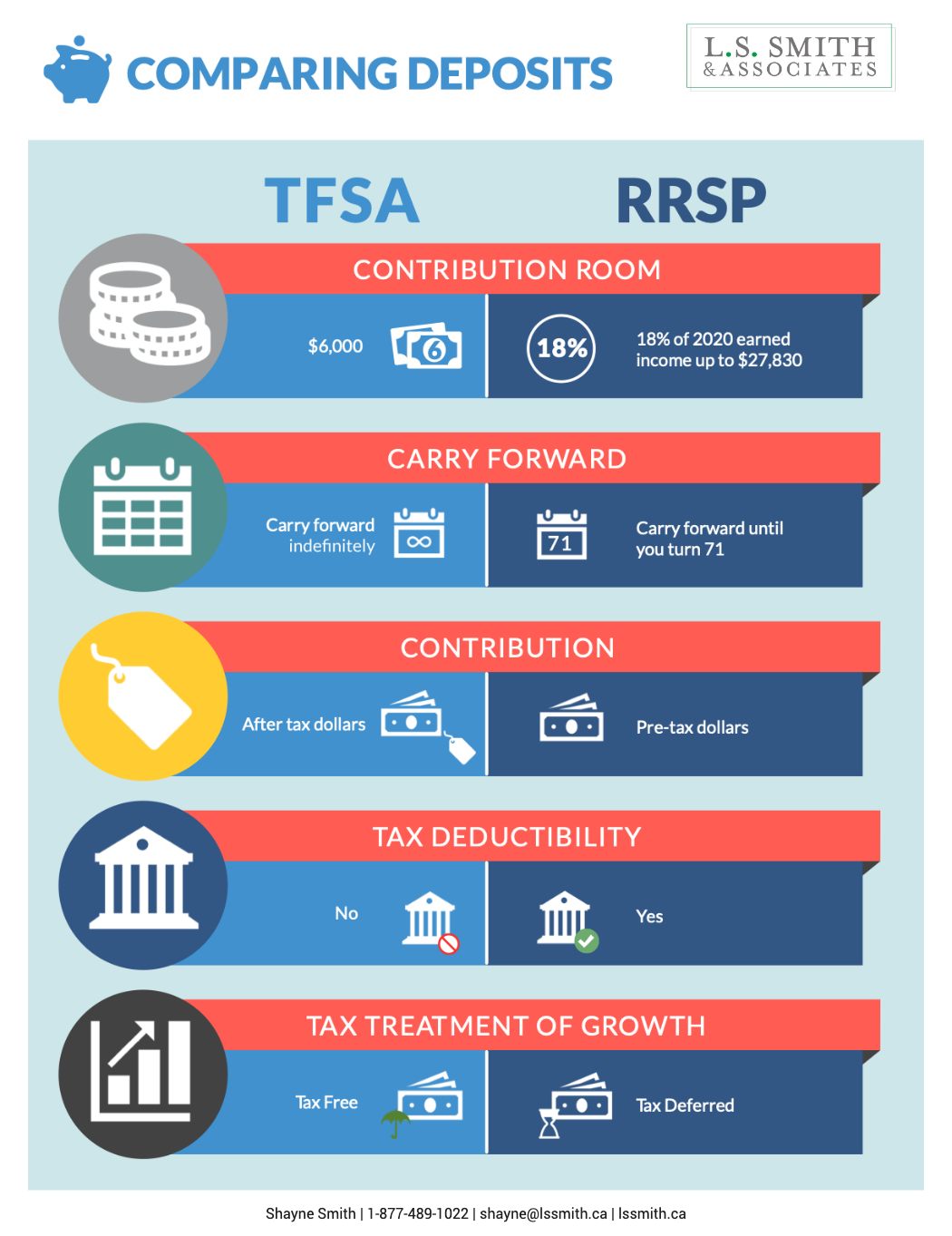
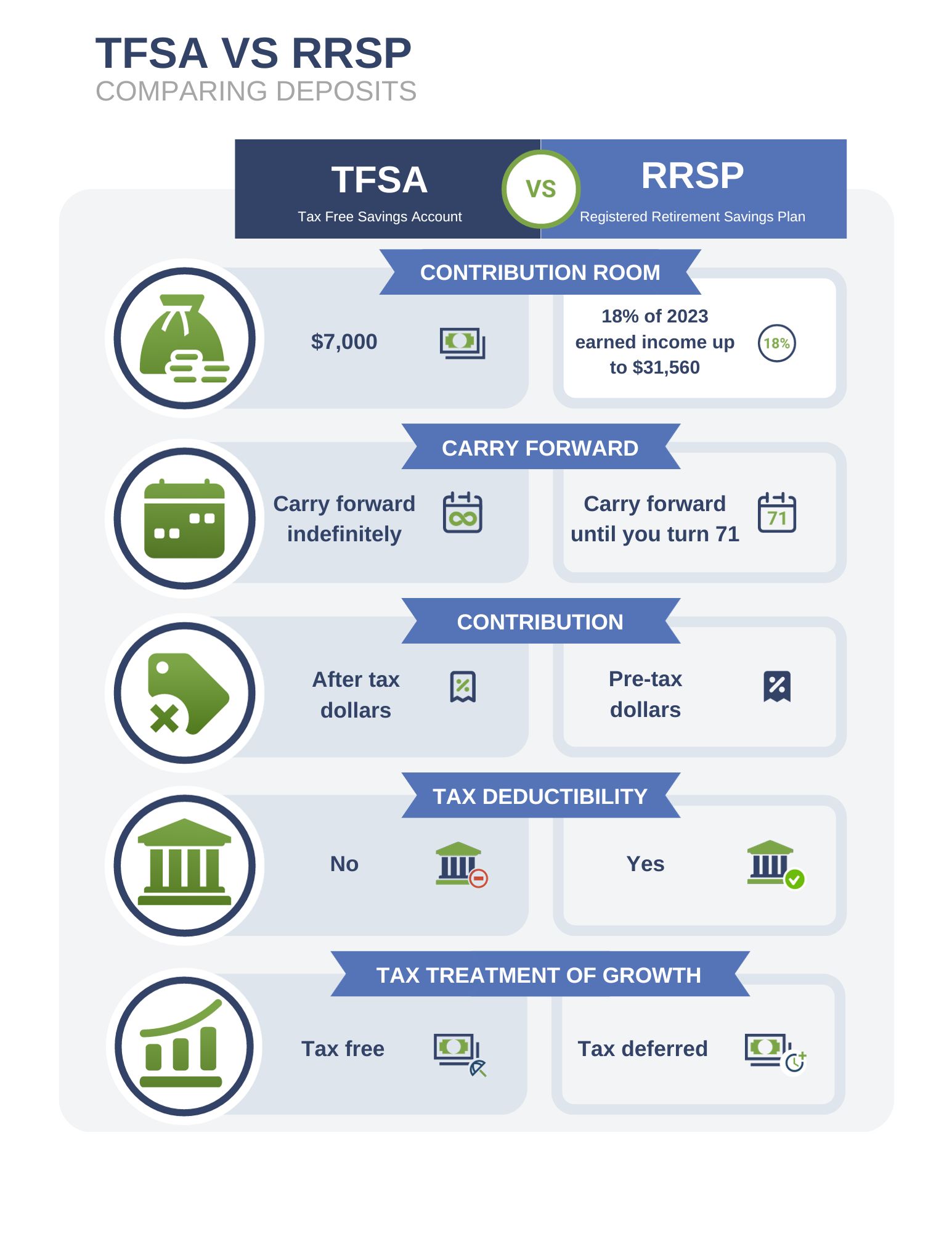
    When comparing deposit differences between TFSAs and RRSPs, there are several key considerations: 

    • The amount of contribution room available
    • The ability to carry forward unused contributions
    • The tax deductibility of contributions
    • The tax treatment of growth in the account


    How much contribution room do I have? 

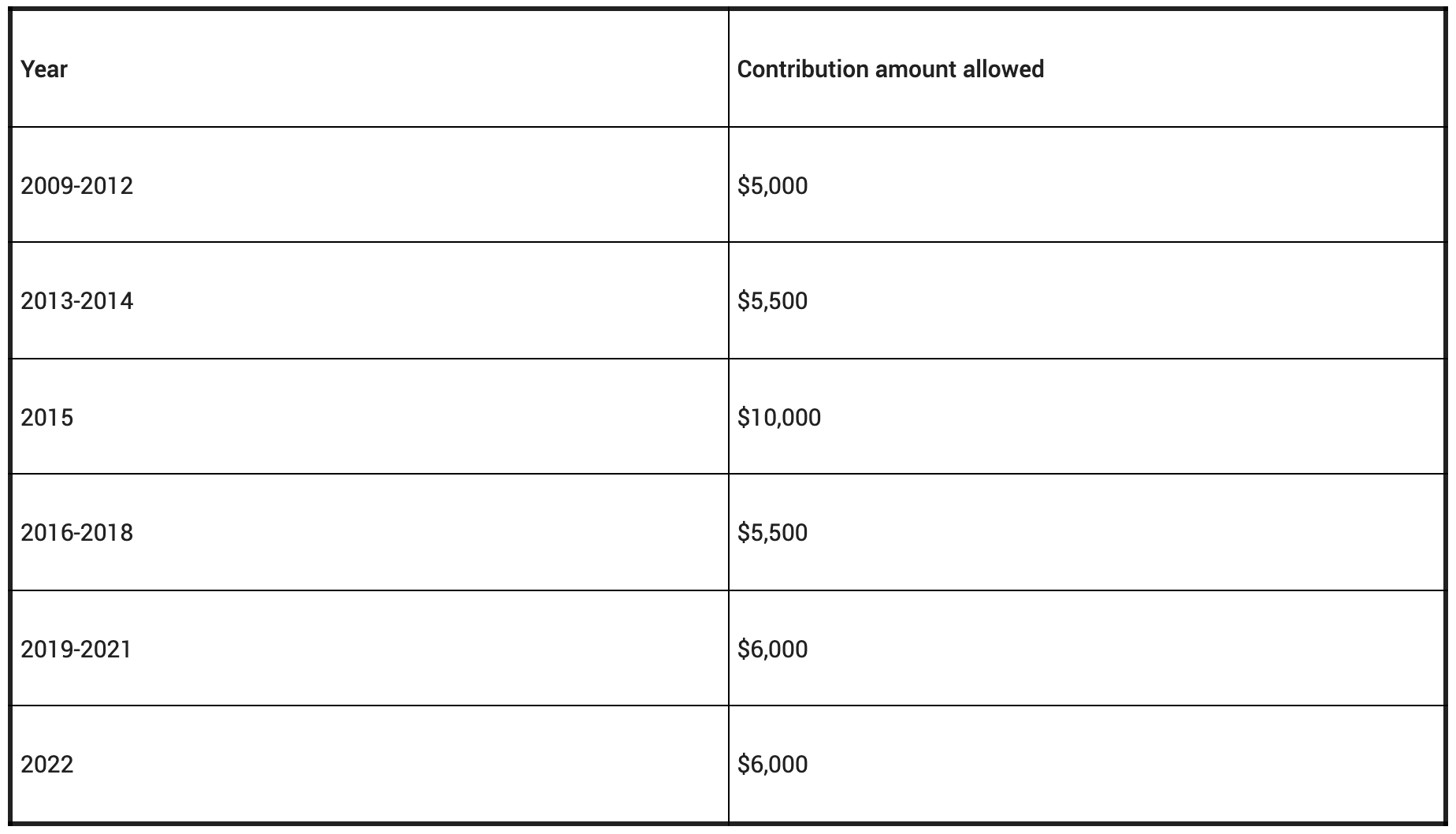
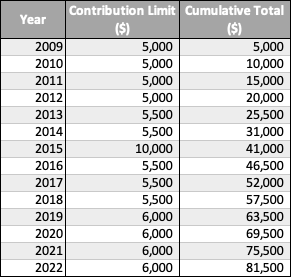
    If you have never contributed to a TFSA since 2009, you can contribute up to $102,000 today. This table outlines the contribution amount you are allowed each year since TFSAs were created, including this year: 

    Regarding RRSPs, the limit for tax deductions is 18% of your pre-tax earned income from the previous year, with a maximum limit of $32,490. To illustrate, if your pre-tax income in 2024 was $60,000, your deduction limit for 2024 would be $10,800 (18% x $60,000). If your pre-tax income was $200,000, the maximum limit of $32,490 would apply. 

    How much contribution room can I carry forward? 

    Suppose you opt not to contribute to your TFSA each year or do not contribute the maximum amount. In that case, you can carry forward your unused contribution room indefinitely, provided you are a Canadian resident, over 18 years of age, and have a valid social insurance number. If you make a withdrawal, the amount withdrawn will be added to your annual contribution room for the next calendar year. 

    In contrast, for an RRSP, you can carry forward your unused contribution room until age 71. Once you reach 71, you are required to convert your RRSP into an RRIF. Withdrawals from an RRSP do not create additional contribution room.

    The tax deductibility of contributions

    Your TFSA contributions are not tax-deductible and are made with after-tax dollars. 

    Your RRSP contributions are tax-deductible and made with pre-tax dollars. 

    Tax Treatment of Growth 

    It is essential to contribute to both RRSP and TFSA because of the different tax treatment of the growth within them. 

    A TFSA is ideal for short-term goals, such as saving for a down payment on a house or a vacation, as its growth is entirely tax-free. When withdrawing from your TFSA, you will not have to pay any income tax on the amount withdrawn. On the other hand, the growth within an RRSP is tax-deferred. This means you will not pay taxes on your RRSP gains until age 71, at which point you convert the RRSP into an RRIF and start withdrawing money. 

    RRSPs are more suitable for long-term goals such as retirement because, in retirement, you will have a lower income and be in a lower tax bracket, resulting in less tax on your RRIF income.

    brandableContent

    TFSA versus RRSP – Differences in withdrawals 

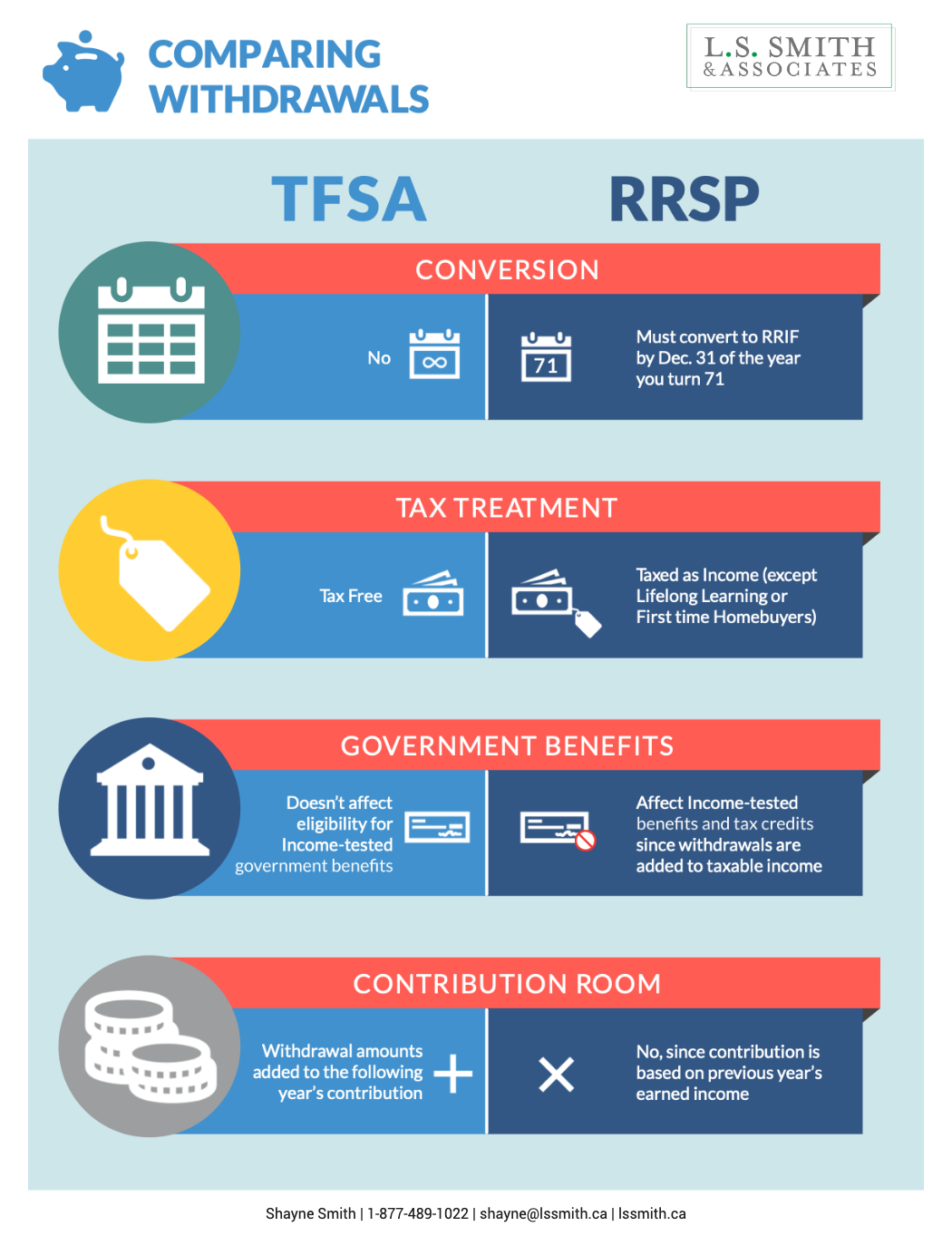
    There are several areas to focus on when comparing differences in withdrawal: 

    • Conversion Requirements 
    • Tax Treatment 
    • Government Benefits 
    • Contribution Room 

    Conversion Requirements 

    For a TFSA, there are never any conversion requirements as there is no maximum age for a TFSA. 

    For an RRSP, you must convert it to a Registered Retirement Income Fund (RRIF) if you turn 71 by December 31st, 2025. 

    Tax Treatment of Withdrawals 

    One of the most attractive things about a TFSA is that all your withdrawals are tax-free! Therefore, they are recommended for short-term goals; you don’t have to worry about taxes when you take money out to pay for a house or a dream vacation. 

    With an RRSP, if you make a withdrawal, it will be taxed as income except in two cases: 

    • The Home Buyers Plan lets you withdraw up to $60,000 tax-free, but you must pay it back within fifteen years. 
    • The Lifelong Learning Plan lets you withdraw up to $20,000 ($10,000 maximum per year) tax-free, but you must pay it back within ten years. 

    How will my government benefits be impacted? 

    If you are withdrawing from your TFSA or RRSP, it’s essential to know how that will affect any benefits you receive from the government. 

    Since TFSA withdrawals are not considered taxable income, they will not impact your eligibility for income-tested government benefits. 

    RRSP withdrawals are considered taxable income and can affect the following: 

    • Income-tested tax credits such as Canada Child Tax Benefit, the Working Income Tax Benefit, the Goods and Services Tax Credit, and the Age Credit. 
    • Government benefits including Old Age Security, Guaranteed Income Supplement and Employment Insurance. 

    How will a withdrawal impact my contribution room? 

    If you withdraw from your TFSA, the amount you withdrew will be added on top of your annual contribution room for the following calendar year. If you withdraw from your RRSP, you do not open any additional contribution room. 

    The Takeaway 

    RRSPs and TFSAs can both be great savings vehicles. However, there are significant differences between them which can affect your finances. If you need help navigating these differences, please do not hesitate to contact us. We’re here to help.

    Sources:

    • https://www.canada.ca/en/revenue-agency/services/tax/individuals/topics/rrsps-related-plans/registered-retirement-savings-plan-rrsp.html
    • https://www.canada.ca/en/revenue-agency/services/tax/individuals/topics/tax-free-savings-account.html

    https://lssmith.ca/wp-content/uploads/2025/02/TFSA-vs-RRSP-2025-1.png 300 500 LS Smith & Associates https://lssmith.ca/wp-content/uploads/2018/05/lsSmithLogo.jpg LS Smith & Associates2025-02-06 06:09:412025-02-06 06:09:52TFSA vs RRSP 2025

    TFSA vs RRSP 2025

    February 1, 2025/in Blog, Investment, rrsp, Tax Free Savings Account/by LS Smith & Associates

    When looking to save money in a tax-efficient manner, Tax-Free Savings Accounts (TFSA) and Registered Retirement Savings Plans (RRSP) can offer significant tax benefits. To assist you in understanding the distinctions, we will compare the following:

    • The differences in deposits between TFSAs and RRSPs
    • The differences in withdrawals between TFSAs and RRSPs
    brandableContent

    TFSA versus RRSP – Difference in deposits 

    When comparing deposit differences between TFSAs and RRSPs, there are several key considerations: 

    • The amount of contribution room available
    • The ability to carry forward unused contributions
    • The tax deductibility of contributions
    • The tax treatment of growth in the account


    How much contribution room do I have? 

    If you have never contributed to a TFSA since 2009, you can contribute up to $102,000 today. This table outlines the contribution amount you are allowed each year since TFSAs were created, including this year: 

    Regarding RRSPs, the limit for tax deductions is 18% of your pre-tax earned income from the previous year, with a maximum limit of $32,490. To illustrate, if your pre-tax income in 2024 was $60,000, your deduction limit for 2024 would be $10,800 (18% x $60,000). If your pre-tax income was $200,000, the maximum limit of $32,490 would apply. 

    How much contribution room can I carry forward? 

    Suppose you opt not to contribute to your TFSA each year or do not contribute the maximum amount. In that case, you can carry forward your unused contribution room indefinitely, provided you are a Canadian resident, over 18 years of age, and have a valid social insurance number. If you make a withdrawal, the amount withdrawn will be added to your annual contribution room for the next calendar year. 

    In contrast, for an RRSP, you can carry forward your unused contribution room until age 71. Once you reach 71, you are required to convert your RRSP into an RRIF. Withdrawals from an RRSP do not create additional contribution room.

    The tax deductibility of contributions

    Your TFSA contributions are not tax-deductible and are made with after-tax dollars. 

    Your RRSP contributions are tax-deductible and made with pre-tax dollars. 

    Tax Treatment of Growth 

    It is essential to contribute to both RRSP and TFSA because of the different tax treatment of the growth within them. 

    A TFSA is ideal for short-term goals, such as saving for a down payment on a house or a vacation, as its growth is entirely tax-free. When withdrawing from your TFSA, you will not have to pay any income tax on the amount withdrawn. On the other hand, the growth within an RRSP is tax-deferred. This means you will not pay taxes on your RRSP gains until age 71, at which point you convert the RRSP into an RRIF and start withdrawing money. 

    RRSPs are more suitable for long-term goals such as retirement because, in retirement, you will have a lower income and be in a lower tax bracket, resulting in less tax on your RRIF income.

    brandableContent

    TFSA versus RRSP – Differences in withdrawals 

    There are several areas to focus on when comparing differences in withdrawal: 

    • Conversion Requirements 
    • Tax Treatment 
    • Government Benefits 
    • Contribution Room 

    Conversion Requirements 

    For a TFSA, there are never any conversion requirements as there is no maximum age for a TFSA. 

    For an RRSP, you must convert it to a Registered Retirement Income Fund (RRIF) if you turn 71 by December 31st, 2025. 

    Tax Treatment of Withdrawals 

    One of the most attractive things about a TFSA is that all your withdrawals are tax-free! Therefore, they are recommended for short-term goals; you don’t have to worry about taxes when you take money out to pay for a house or a dream vacation. 

    With an RRSP, if you make a withdrawal, it will be taxed as income except in two cases: 

    • The Home Buyers Plan lets you withdraw up to $60,000 tax-free, but you must pay it back within fifteen years. 
    • The Lifelong Learning Plan lets you withdraw up to $20,000 ($10,000 maximum per year) tax-free, but you must pay it back within ten years. 

    How will my government benefits be impacted? 

    If you are withdrawing from your TFSA or RRSP, it’s essential to know how that will affect any benefits you receive from the government. 

    Since TFSA withdrawals are not considered taxable income, they will not impact your eligibility for income-tested government benefits. 

    RRSP withdrawals are considered taxable income and can affect the following: 

    • Income-tested tax credits such as Canada Child Tax Benefit, the Working Income Tax Benefit, the Goods and Services Tax Credit, and the Age Credit. 
    • Government benefits including Old Age Security, Guaranteed Income Supplement and Employment Insurance. 

    How will a withdrawal impact my contribution room? 

    If you withdraw from your TFSA, the amount you withdrew will be added on top of your annual contribution room for the following calendar year. If you withdraw from your RRSP, you do not open any additional contribution room. 

    The Takeaway 

    RRSPs and TFSAs can both be great savings vehicles. However, there are significant differences between them which can affect your finances. If you need help navigating these differences, please do not hesitate to contact us. We’re here to help.

    https://lssmith.ca/wp-content/uploads/2025/02/TFSA-vs-RRSP-2025.png 300 500 LS Smith & Associates https://lssmith.ca/wp-content/uploads/2018/05/lsSmithLogo.jpg LS Smith & Associates2025-02-01 06:00:522025-02-01 06:01:01TFSA vs RRSP 2025

    Retirement Planning for Business Owners

    January 14, 2025/in Blog, business owners, corporate, Retirees, rrsp, tax, Tax Free Savings Account/by LS Smith & Associates

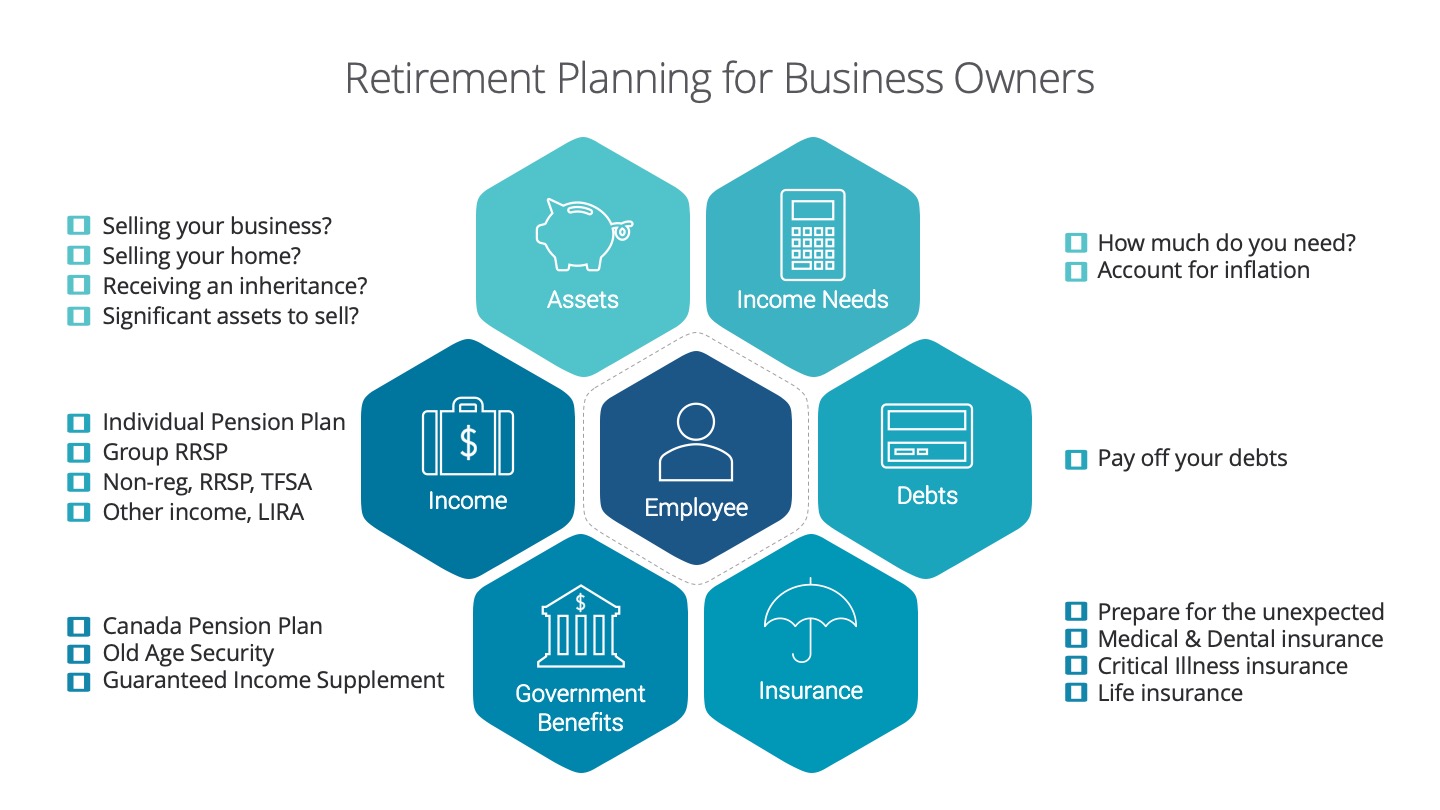
    Retirement planning can be a complex process for us all, but if you are the owner of a small business it may can get even more complicated, due to the various factors and circumstances that you have to take into consideration. A common mistake made by small business owners is reinvesting extra money to grow their business, at the expense of putting it aside to save for their retirement.

    Although there is no magic formula for getting started on a retirement strategy for your business, there are some general principles which might help you to get a handle on the steps that you need to take. One of the key ideas is the consideration of both your business and your personal finances and how to structure and integrate the two in order to create a robust retirement financial strategy.

    Here are some tips on how to get started on a retirement plan.

    • Set aside time to plan for the future – It’s important to make retirement planning a priority, or you run the risk of never getting around to it. A professional financial planner can help you to assess your personal circumstances and create a personalized plan that suits you and your business, with the right balance between saving and reinvestment to help your business to grow.
    • Think about your future retirement income – Here are the main sources of retirement income that small business owners usually rely on:
    1. Equity held in your business – If your business is successful, you are likely to benefit from equity from it in your retirement. Selling your company is an option, particularly attractive to some as, in some cases, you could benefit from the lifetime capital gains exemption on the sale. Of course, finding the right person to run your business in the future is easier said than done. A clear succession plan, created in advance of your retirement, can help you to ensure that business continuity will be affected as little as possible and will give you peace of mind as you approach your retirement. You may also want to consider using the expertise of an accountant or mergers and acquisitions specialist to help you to value your business correctly and also look after your interests when liaising with potential purchasers.
    2. Alternatively, you may choose for your children to inherit your business, or you may decide to retain ownership of dividend-paying preferred shares in order to maintain an ongoing source of income.
    3. Registered plans – A Registered Retirement Savings Plan (RRSP) can offer personal tax deductions on your contributions, plus your savings will grow as tax-deferred whilst in the plan. In addition, tax-free savings accounts (TFSAs) can be a useful way to save tax-free in particular circumstances.
    • Consider offering a retirement savings plan to your employees – Paying your statutory contribution of the Canada Pension Plan is just the minimum – many small businesses choose to offer their employees enhanced pension contributions as an incentive or employee benefit. For example, you could match their RRSP contributions to a set limit, to help their retirement nest grow more quickly. Alternatively, you could offer a benefit plan with an investment contribution package from an insurance company, which can be a more straightforward and cost-effective choice.
    • Be sure to diversify – As a small business owner, you should avoid putting all of your eggs in one basket, financially speaking, as this could leave you vulnerable to changes in the market. Try to diversify your investments and spread your funds in order to protect yourself and engage the help of a professional where necessary to help you to do so.

    In summary, it’s important to remember that retirement planning is a process which is unique and personal to your own and your business’ circumstances and there is no uniform approach which works across the board. Take time to take stock of your current situation, as well as your goals for the future and this will help you to create a retirement plan that is right for your needs, both current and future.

    Contact us

    https://lssmith.ca/wp-content/uploads/2025/01/retirementPlanningBOFI.png 512 1024 LS Smith & Associates https://lssmith.ca/wp-content/uploads/2018/05/lsSmithLogo.jpg LS Smith & Associates2025-01-14 05:05:422025-01-14 05:05:57Retirement Planning for Business Owners

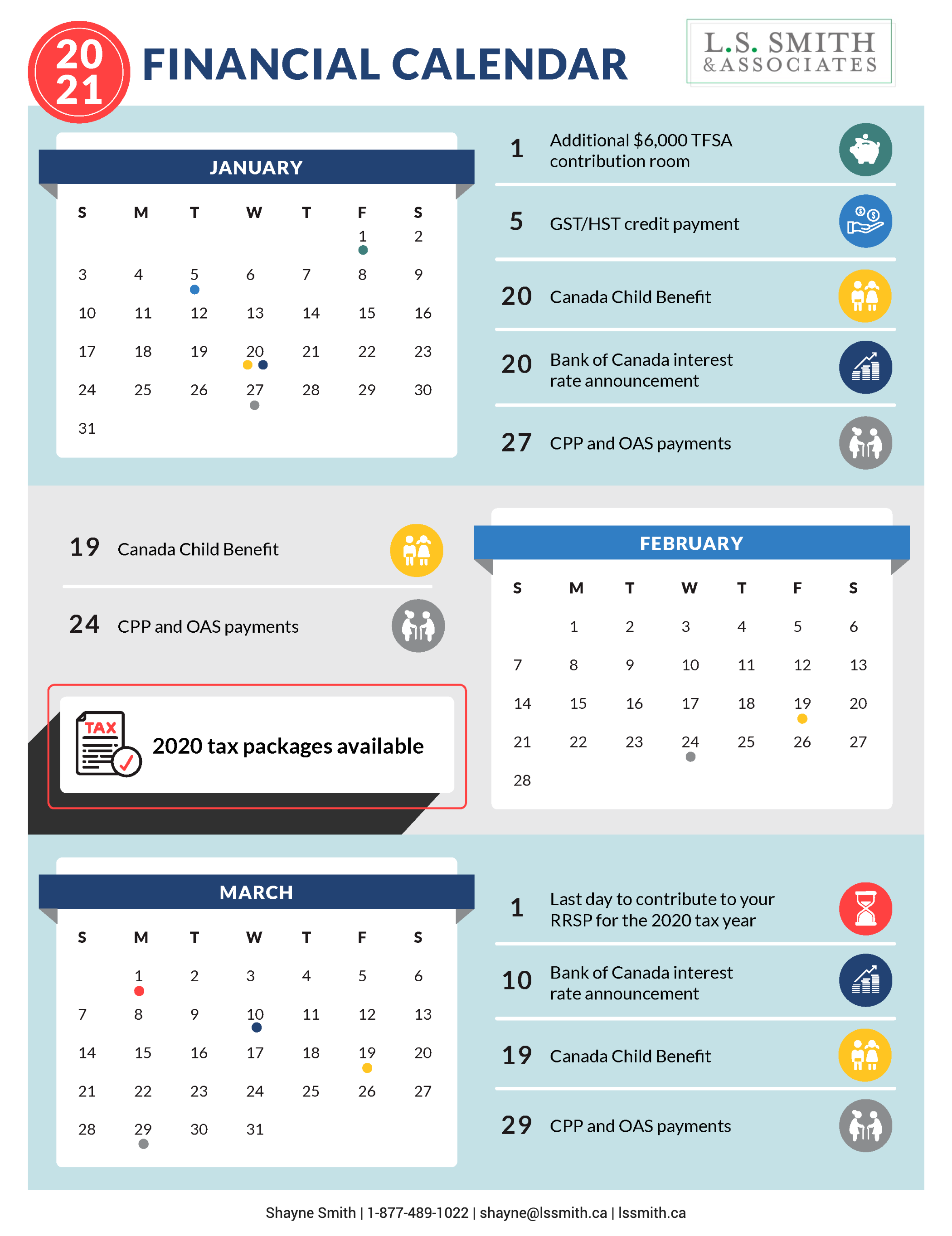
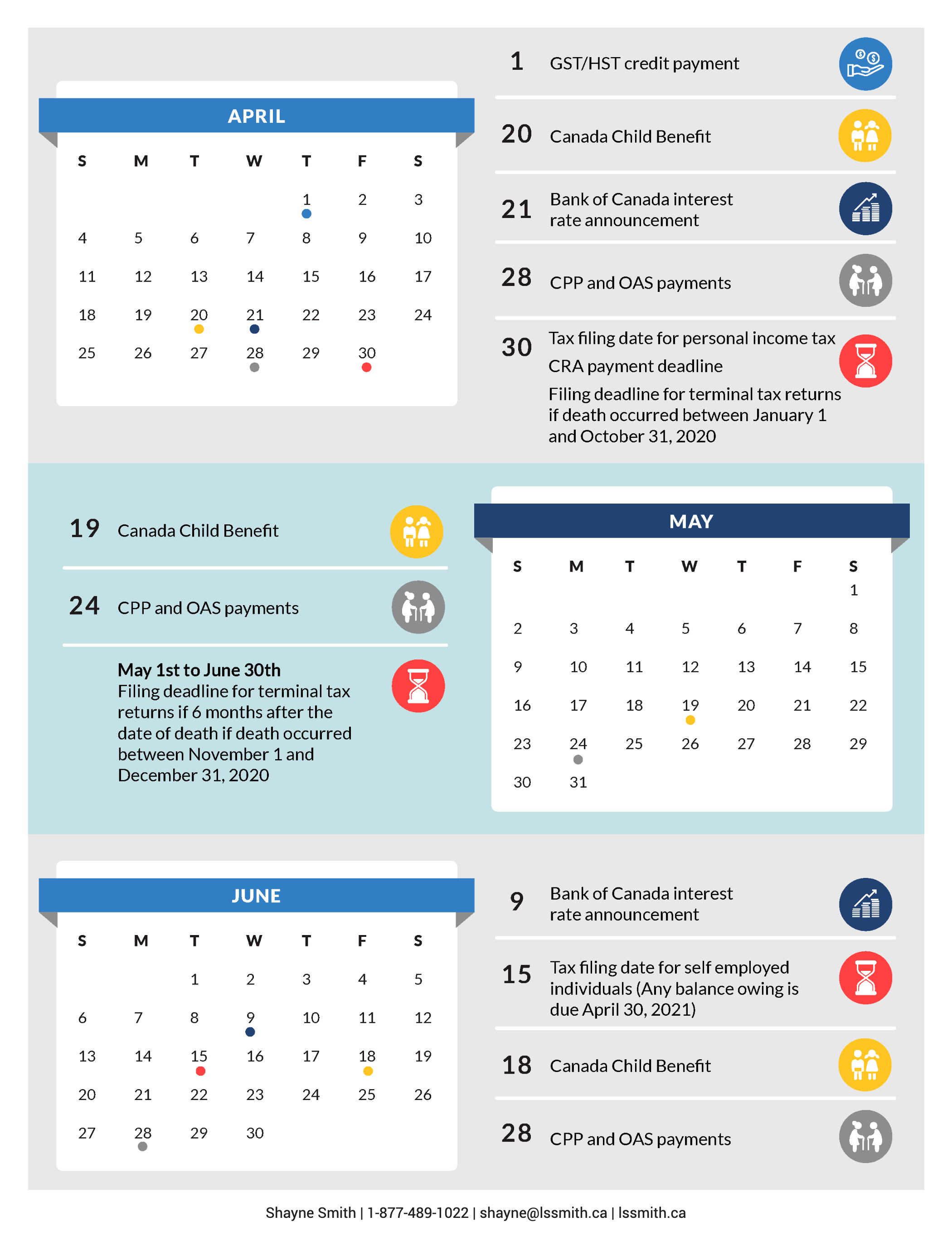
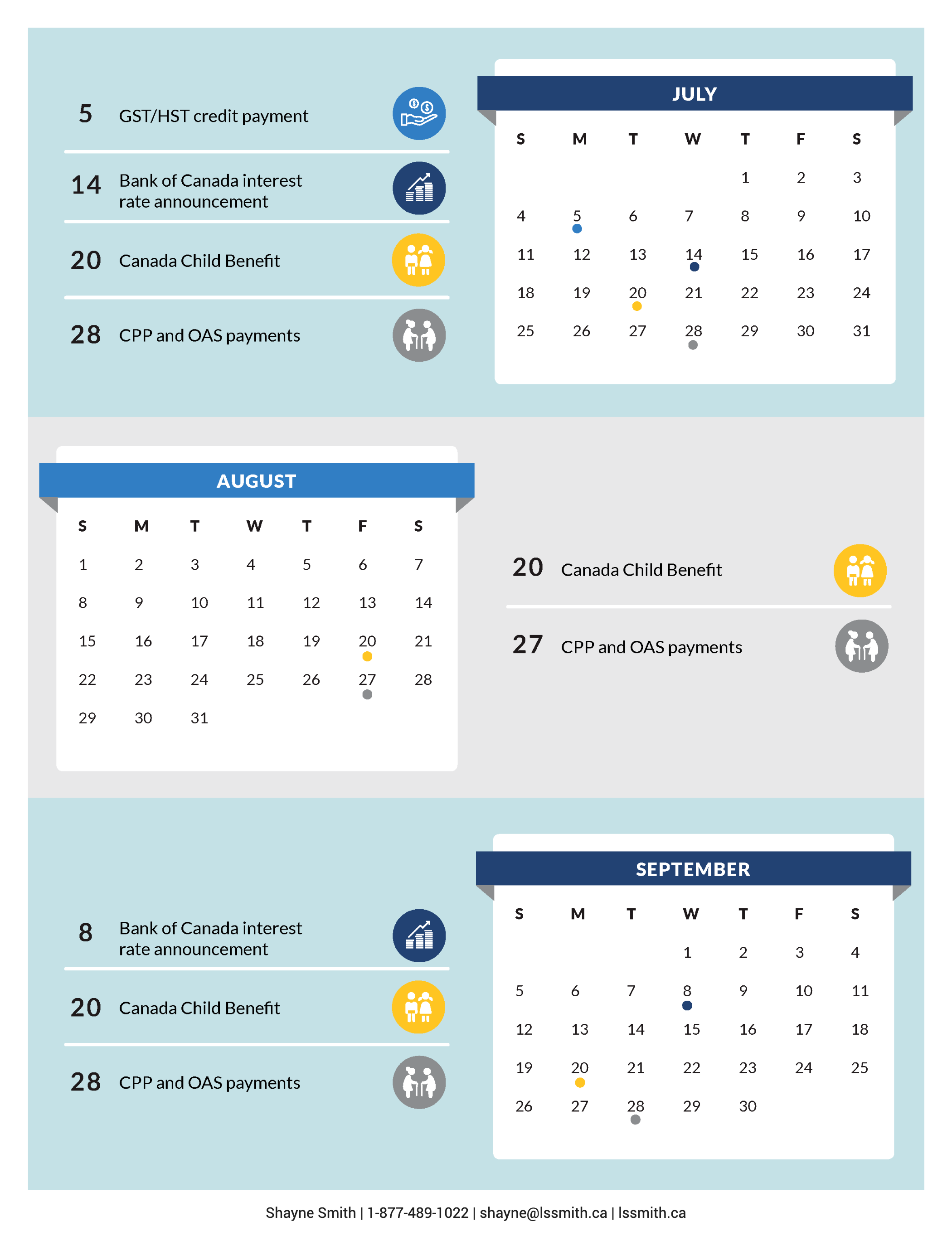
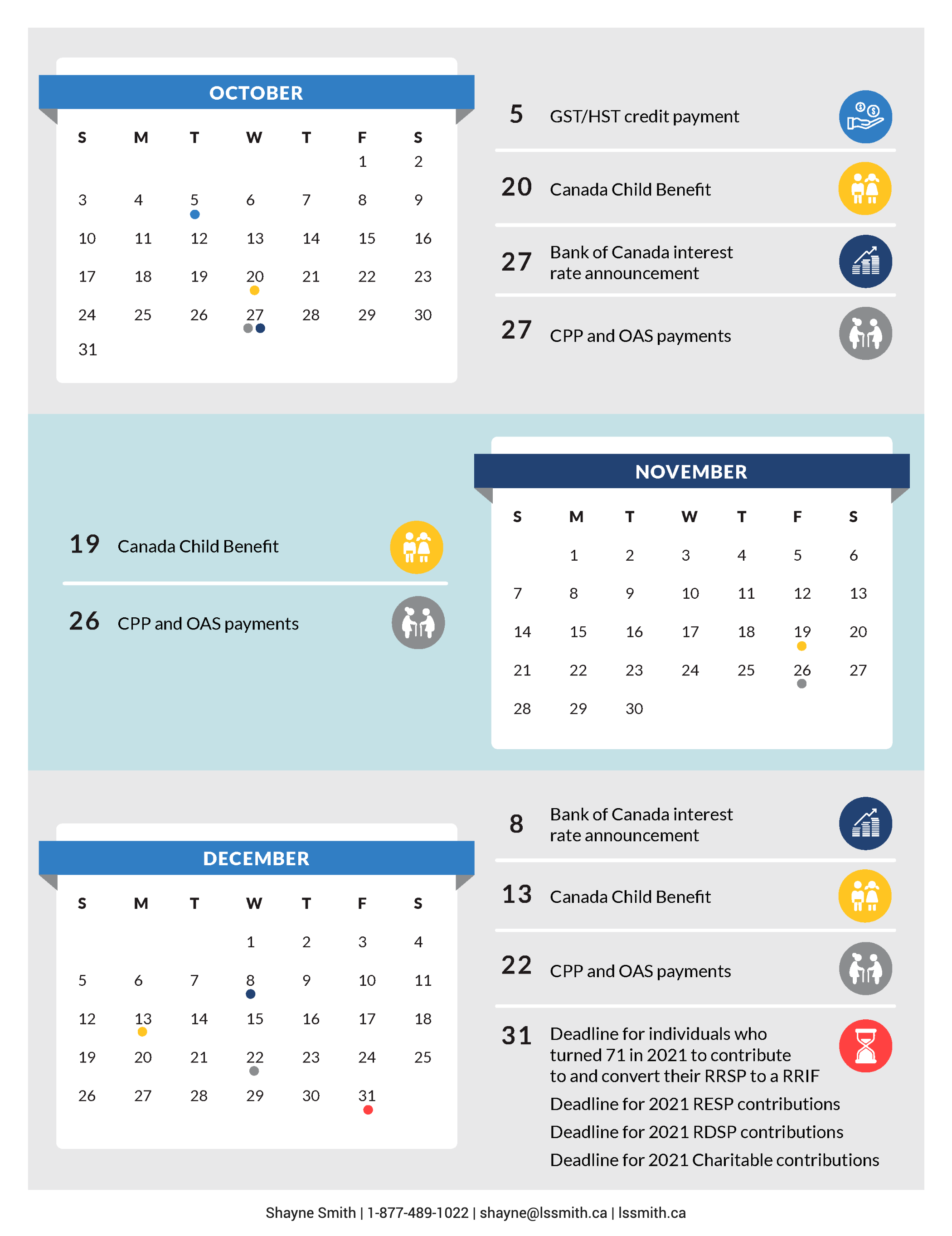
    2025 Financial Calendar

    January 1, 2025/in Blog, Family, Financial Planning, personal finances, rrsp, tax, Tax Free Savings Account/by LS Smith & Associates

    brandableContent
    brandableContent
    brandableContent
    brandableContent
    brandableContent

    Welcome to our 2025 financial calendar! This calendar is designed to help you keep track of important financial dates and deadlines, such as tax filing and government benefit distribution. You can bookmark this page for easy reference or add these dates to your personal calendar to ensure you don’t miss any important financial obligations.

    If you need help with your taxes, tax packages will be available starting February 2024. Don’t wait until the last minute to get started on your tax return – make an appointment with your accountant to ensure you’re ready to go when tax season arrives.

    Important 2024 Dates to Know

    On January 1, 2025, the contribution room for your Tax-Free Savings Account (TFSA) opens again. For those that are eligible, the contribution rooms for your Registered Retirement Savings Plan (RRSP), First Home Savings Account (FHSA), Registered Education Savings Plan (RESP), and Registered Disability Savings Plan (RDSP) will also be available.

    For your Registered Retirement Savings Plan contributions to be eligible for the 2024 income tax year, you must make them by March 3, 2025.

    GST/HST credit payments will be issued on:

    • January 3

    • April 4

    • July 4

    • October 3

    Canada Child Benefit payments will be issued on the following dates:

    • January 20

    • February 20

    • March 20

    • April 17

    • May 20

    • June 20

    • July 18

    • August 20

    • September 19

    • October 20

    • November 20

    • December 12

    The government will issue Canada Pension Plan and Old Age Security payments on the following dates:

    • January 29

    • February 26

    • March 27

    • April 28

    • May 28

    • June 26

    • July 29

    • August 27

    • September 25

    • October 29

    • November 26

    • December 22

    The Bank of Canada will make interest rate announcements on:

    • January 29

    • March 12

    • April 16

    • June 4

    • July 30

    • September 17

    • October 29

    • December 10

    April 30, 2025, is the last day to file your personal income taxes, and tax payments are due by this date. This is also the filing deadline for final returns if death occurred between January 1 and October 31, 2024.

    May 1 to June 30, 2025, would be the filing deadline for final tax returns if death occurred between November 1 and December 31, 2024. The due date for the final return is six months after the date of death.

    The tax deadline for all self-employment returns is June 16, 2025. Payments are due April 30, 2025.

    The final Tax-Free Savings Account, First Home Savings Account, Registered Education Savings Plan and Registered Disability Savings Plan contributions deadline is December 31, 2025.

    December 31, 2025 is also the deadline for 2025 charitable contributions.

    December 31, 2025 is also the deadline for individuals who turned 71 in 2025 to finish contributing to their RRSPs and convert them into RRIFs.

    Please reach out if you have any questions.


    Sources:

    https://www.canada.ca/en/revenue-agency/services/tax/individuals/life-events/doing-taxes-someone-died/prepare-returns/filing-deadlines.html

    https://www.canada.ca/en/revenue-agency/services/child-family-benefits/benefit-payment-dates.html

    https://www.canada.ca/en/revenue-agency/services/tax/individuals/topics/rrsps-related-plans/important-dates-rrsp-rrif-rdsp.html

    https://www.canada.ca/en/revenue-agency/news/newsroom/tax-tips/tax-tips-2024/planning-file-your-tax-return-on-paper-here-what-you-need-know.html

    https://www.bankofcanada.ca/2024/08/bank-canada-publishes-2025-schedule-policy-interest-rate-announcements-other-major-publications/

    https://www.canada.ca/content/dam/cra-arc/camp-promo/smll-bsnss-wk-e.pdf

    https://lssmith.ca/wp-content/uploads/2025/01/2025-Financial-Calendar.png 280 500 LS Smith & Associates https://lssmith.ca/wp-content/uploads/2018/05/lsSmithLogo.jpg LS Smith & Associates2025-01-01 07:23:512025-01-01 07:23:592025 Financial Calendar

    2025 Financial Calendar

    December 31, 2024/in Blog, Family, Financial Planning, personal finances, rrsp, tax, Tax Free Savings Account/by LS Smith & Associates

    brandableContent
    brandableContent
    brandableContent
    brandableContent
    brandableContent

    Welcome to our 2025 financial calendar! This calendar is designed to help you keep track of important financial dates and deadlines, such as tax filing and government benefit distribution. You can bookmark this page for easy reference or add these dates to your personal calendar to ensure you don’t miss any important financial obligations.

    If you need help with your taxes, tax packages will be available starting February 2024. Don’t wait until the last minute to get started on your tax return – make an appointment with your accountant to ensure you’re ready to go when tax season arrives.

    Important 2024 Dates to Know

    On January 1, 2025, the contribution room for your Tax-Free Savings Account (TFSA) opens again. For those that are eligible, the contribution rooms for your Registered Retirement Savings Plan (RRSP), First Home Savings Account (FHSA), Registered Education Savings Plan (RESP), and Registered Disability Savings Plan (RDSP) will also be available.

    For your Registered Retirement Savings Plan contributions to be eligible for the 2024 income tax year, you must make them by March 3, 2025.

    GST/HST credit payments will be issued on:

    • January 3
    • April 4
    • July 4
    • October 3

    Canada Child Benefit payments will be issued on the following dates:

    • January 20
    • February 20
    • March 20
    • April 17
    • May 20
    • June 20
    • July 18
    • August 20
    • September 19
    • October 20
    • November 20
    • December 12

    The government will issue Canada Pension Plan and Old Age Security payments on the following dates:

    • January 29
    • February 26
    • March 27
    • April 28
    • May 28
    • June 26
    • July 29
    • August 27
    • September 25
    • October 29
    • November 26
    • December 22

    The Bank of Canada will make interest rate announcements on:

    • January 29
    • March 12
    • April 16
    • June 4
    • July 30
    • September 17
    • October 29
    • December 10

    April 30, 2025, is the last day to file your personal income taxes, and tax payments are due by this date. This is also the filing deadline for final returns if death occurred between January 1 and October 31, 2024.

    May 1 to June 30, 2025, would be the filing deadline for final tax returns if death occurred between November 1 and December 31, 2024. The due date for the final return is six months after the date of death.

    The tax deadline for all self-employment returns is June 16, 2025. Payments are due April 30, 2025.

    The final Tax-Free Savings Account, First Home Savings Account, Registered Education Savings Plan and Registered Disability Savings Plan contributions deadline is December 31, 2025.

    December 31, 2025 is also the deadline for 2025 charitable contributions.

    December 31, 2025 is also the deadline for individuals who turned 71 in 2025 to finish contributing to their RRSPs and convert them into RRIFs.

    Please reach out if you have any questions.


    Sources:

    https://www.canada.ca/en/revenue-agency/services/tax/individuals/life-events/doing-taxes-someone-died/prepare-returns/filing-deadlines.html

    https://www.canada.ca/en/revenue-agency/services/child-family-benefits/benefit-payment-dates.html

    https://www.canada.ca/en/revenue-agency/services/tax/individuals/topics/rrsps-related-plans/important-dates-rrsp-rrif-rdsp.html

    https://www.canada.ca/en/revenue-agency/news/newsroom/tax-tips/tax-tips-2024/planning-file-your-tax-return-on-paper-here-what-you-need-know.html

    https://www.bankofcanada.ca/2024/08/bank-canada-publishes-2025-schedule-policy-interest-rate-announcements-other-major-publications/

    https://www.canada.ca/content/dam/cra-arc/camp-promo/smll-bsnss-wk-e.pdf

    https://lssmith.ca/wp-content/uploads/2024/12/2025-Financial-Calendar.png 280 500 LS Smith & Associates https://lssmith.ca/wp-content/uploads/2018/05/lsSmithLogo.jpg LS Smith & Associates2024-12-31 10:15:072024-12-31 10:15:162025 Financial Calendar

    TFSA vs RRSP – 2024

    February 1, 2024/in 2024, Blog, business owners, Estate Planning, Family, financial advice, Financial Planning, individuals, Investment, personal finances, Professionals, retirement, rrsp, Tax Free Savings Account/by LS Smith & Associates

    Tax-Free Savings Account vs Registered Retirement Savings Plan

    When looking to save money in a tax-efficient manner, Tax-Free Savings Accounts (TFSA) and Registered Retirement Savings Plans (RRSP) can offer significant tax benefits. To assist you in understanding the distinctions, we will compare the following:

    • The differences in deposits between TFSAs and RRSPs

    • The differences in withdrawals between TFSAs and RRSPs

    TFSA versus RRSP – Difference in deposits 

    When comparing deposit differences between TFSAs and RRSPs, there are several key considerations: 

    • The amount of contribution room available

    • The ability to carry forward unused contributions

    • The tax deductibility of contributions

    • The tax treatment of growth in the account


    How much contribution room do I have? 

    If you have never contributed to a TFSA, you can contribute up to $95,000 today. This table outlines the contribution amount you are allowed each year since TFSAs were created, including this year:
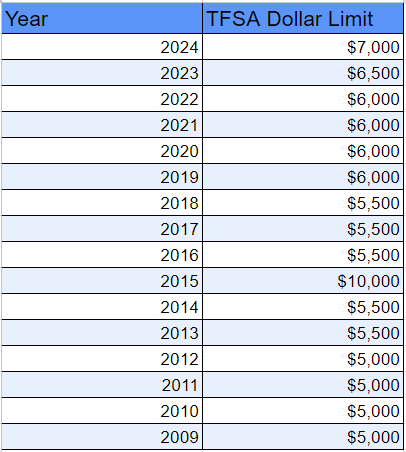
    Regarding RRSPs, the limit for tax deductions is 18% of your pre-tax earned income from the previous year, with a maximum limit of $31,560. To illustrate, if your pre-tax income in 2023 was $60,000, your deduction limit for 2024 would be $10,800 (18% x $60,000). If your pre-tax income was $200,000, the maximum limit of $31,560 would apply. 

    How much contribution room can I carry forward? 

    Suppose you opt not to contribute to your TFSA each year or do not contribute the maximum amount. In that case, you can carry forward your unused contribution room indefinitely, provided you are a Canadian resident, over 18 years of age, and have a valid social insurance number. If you make a withdrawal, the amount withdrawn will be added to your annual contribution room for the next calendar year. 

    In contrast, for an RRSP, you can carry forward your unused contribution room until age 71. Once you reach 71, you are required to convert your RRSP into an RRIF. Withdrawals from an RRSP do not create additional contribution room.

    The tax deductibility of contributions

    Your TFSA contributions are not tax-deductible and are made with after-tax dollars. 

    Your RRSP contributions are tax-deductible and made with pre-tax dollars. 

    Tax Treatment of Growth 

    It is essential to contribute to both RRSP and TFSA because of the different tax treatment of the growth within them. 

    A TFSA is ideal for short-term goals, such as saving for a down payment on a house or a vacation, as its growth is entirely tax-free. When withdrawing from your TFSA, you will not have to pay any income tax on the amount withdrawn. On the other hand, the growth within an RRSP is tax-deferred. This means you will not pay taxes on your RRSP gains until age 71, at which point you convert the RRSP into an RRIF and start withdrawing money. 

    RRSPs are more suitable for long-term goals such as retirement because, in retirement, you will have a lower income and be in a lower tax bracket, resulting in less tax on your RRIF income.
    TFSA versus RRSP – Differences in withdrawals 

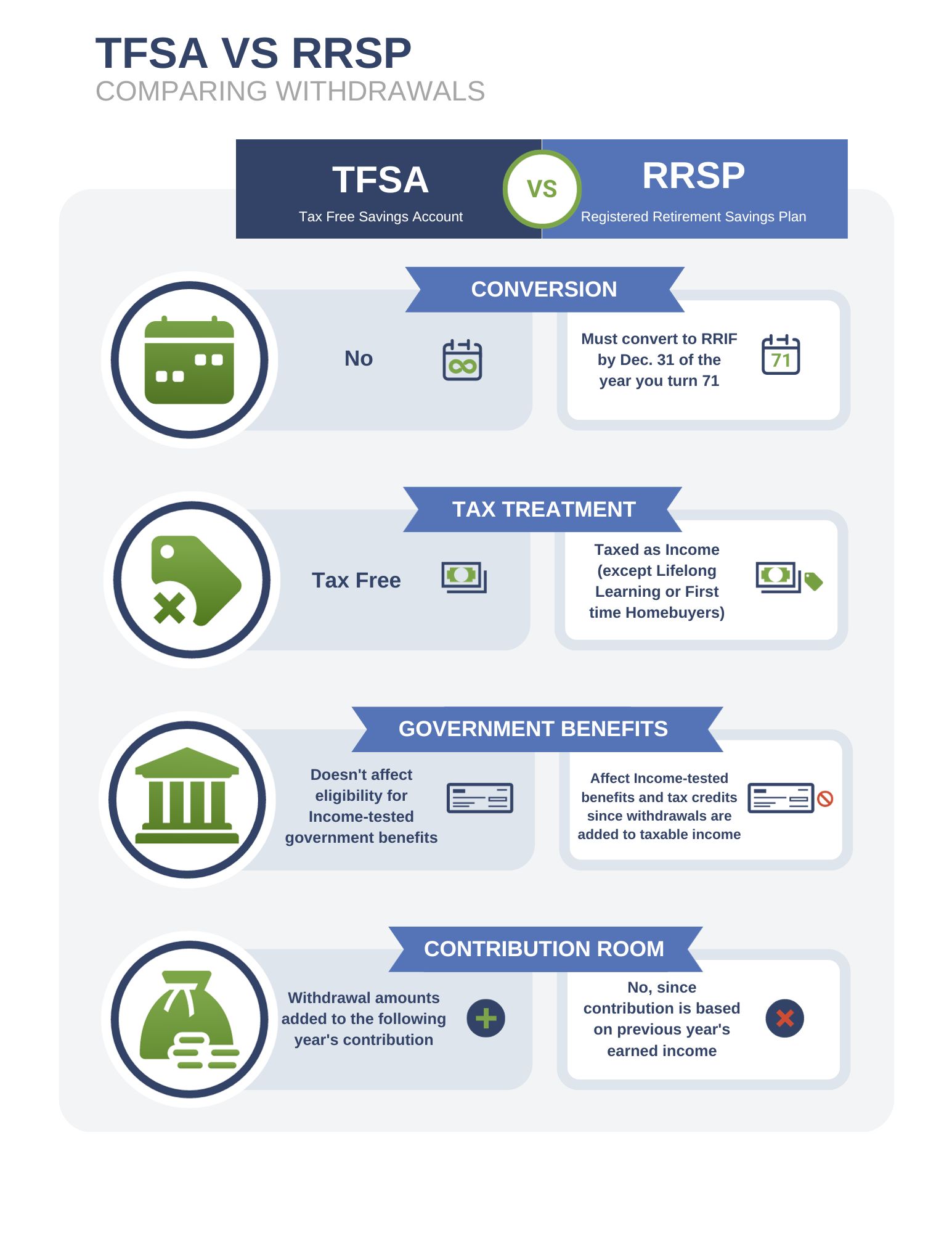
    There are several areas to focus on when comparing differences in withdrawal: 

    • Conversion Requirements 

    • Tax Treatment 

    • Government Benefits 

    • Contribution Room 

    Conversion Requirements 

    For a TFSA, there are never any conversion requirements as there is no maximum age for a TFSA. 

    For an RRSP, you must convert it to a Registered Retirement Income Fund (RRIF) if you turn 71 by December 31st, 2024. 

    Tax Treatment of Withdrawals 

    One of the most attractive things about a TFSA is that all your withdrawals are tax-free! Therefore, they are recommended for short-term goals; you don’t have to worry about taxes when you take money out to pay for a house or a dream vacation. 

    With an RRSP, if you make a withdrawal, it will be taxed as income except in two cases: 

    • The Home Buyers Plan lets you withdraw up to $35,000 tax-free, but you must pay it back within fifteen years. 

    • The Lifelong Learning Plan lets you withdraw up to $20,000 ($10,000 maximum per year) tax-free, but you must pay it back within ten years. 

    How will my government benefits be impacted? 

    If you are withdrawing from your TFSA or RRSP, it’s essential to know how that will affect any benefits you receive from the government. 

    Since TFSA withdrawals are not considered taxable income, they will not impact your eligibility for income-tested government benefits. 

    RRSP withdrawals are considered taxable income and can affect the following: 

    • Income-tested tax credits such as Canada Child Tax Benefit, the Working Income Tax Benefit, the Goods and Services Tax Credit, and the Age Credit. 

    • Government benefits including Old Age Security, Guaranteed Income Supplement and Employment Insurance. 

    How will a withdrawal impact my contribution room? 

    If you withdraw from your TFSA, the amount you withdrew will be added on top of your annual contribution room for the following calendar year. If you withdraw from your RRSP, you do not open any additional contribution room. 

    The Takeaway 

    RRSPs and TFSAs can both be great savings vehicles. However, there are significant differences between them which can affect your finances. If you need help navigating these differences, please do not hesitate to contact us. We’re here to help.

    https://lssmith.ca/wp-content/uploads/2024/02/TFSA-vs-RRSP-2024.png 300 500 LS Smith & Associates https://lssmith.ca/wp-content/uploads/2018/05/lsSmithLogo.jpg LS Smith & Associates2024-02-01 14:33:132024-02-01 14:33:16TFSA vs RRSP – 2024

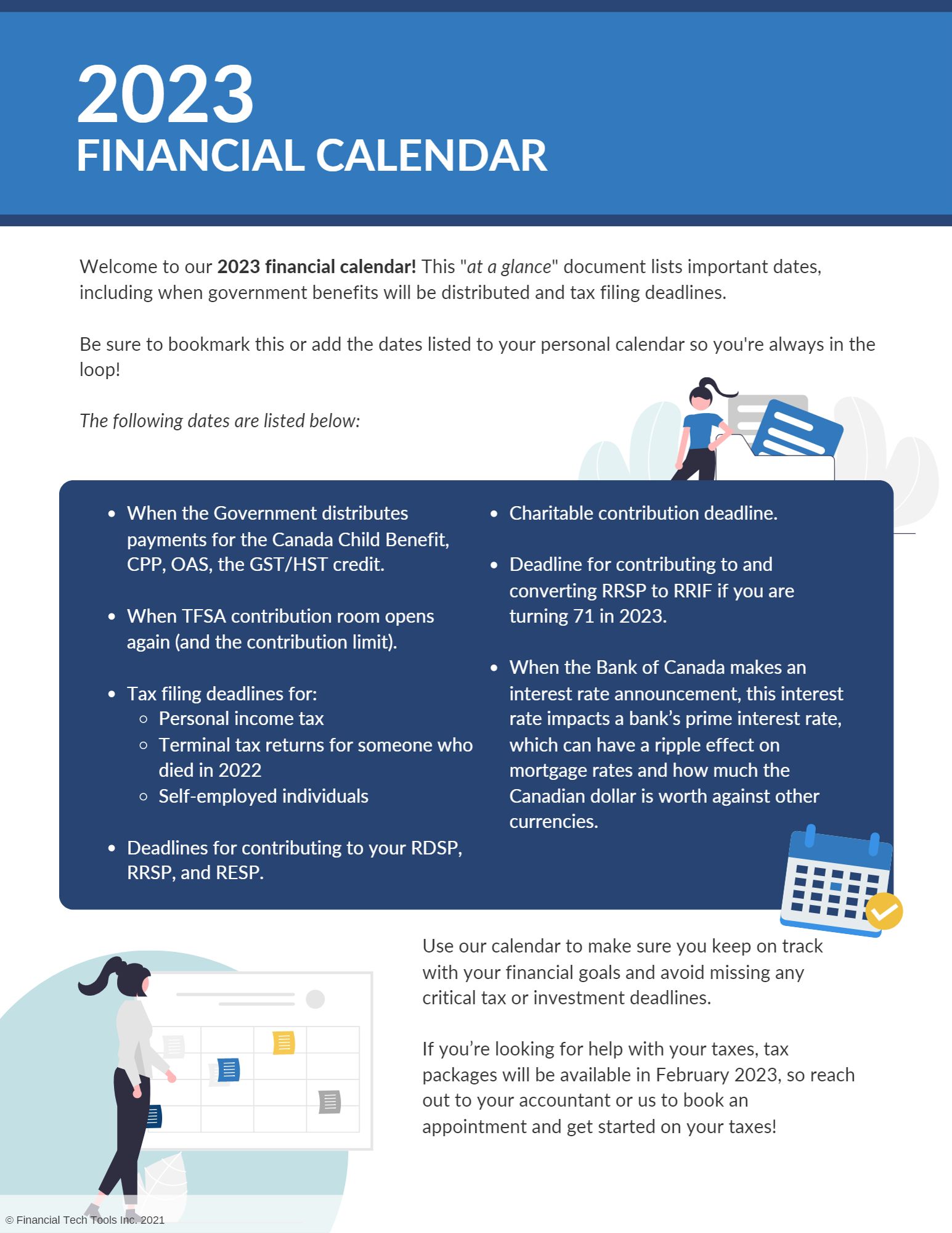
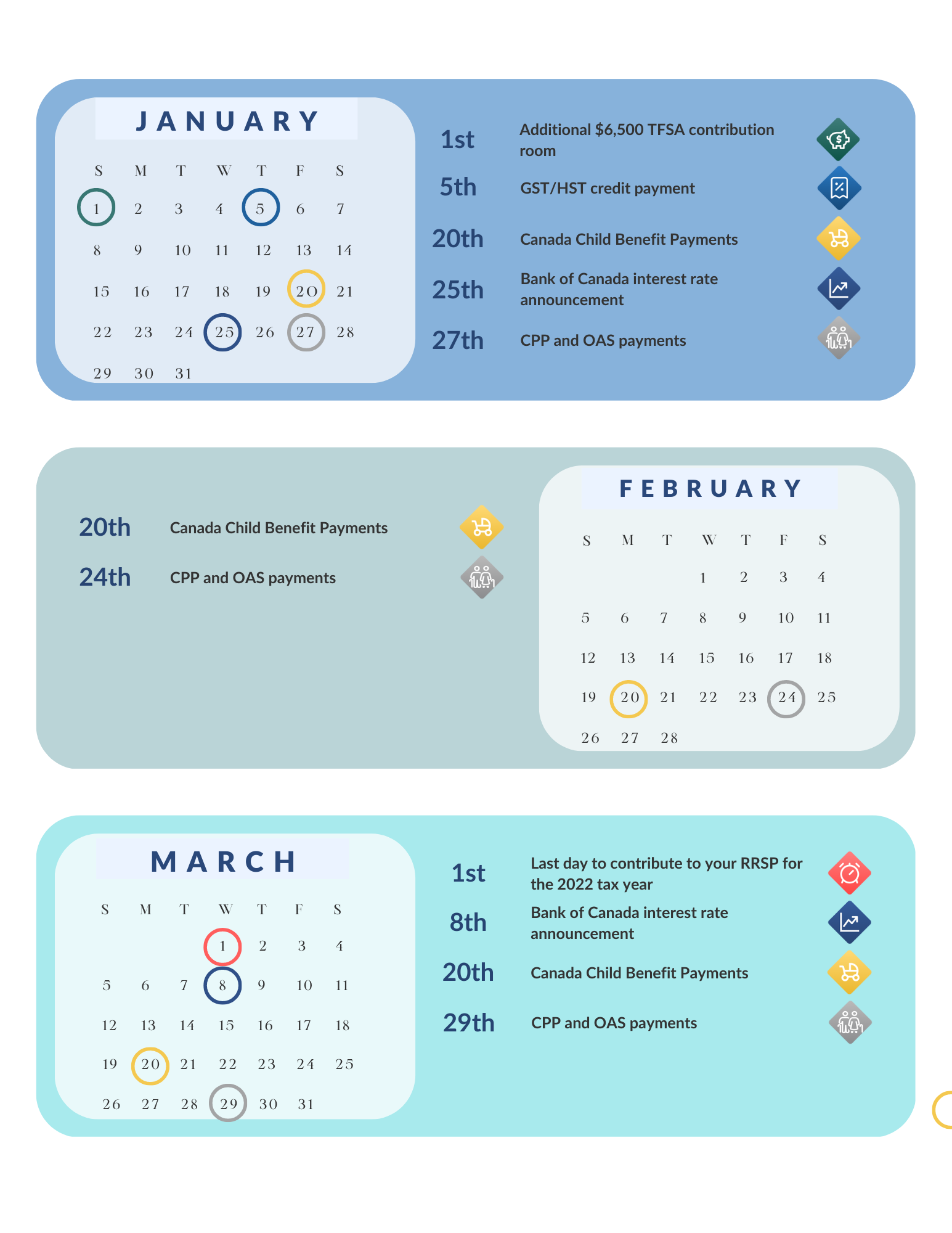
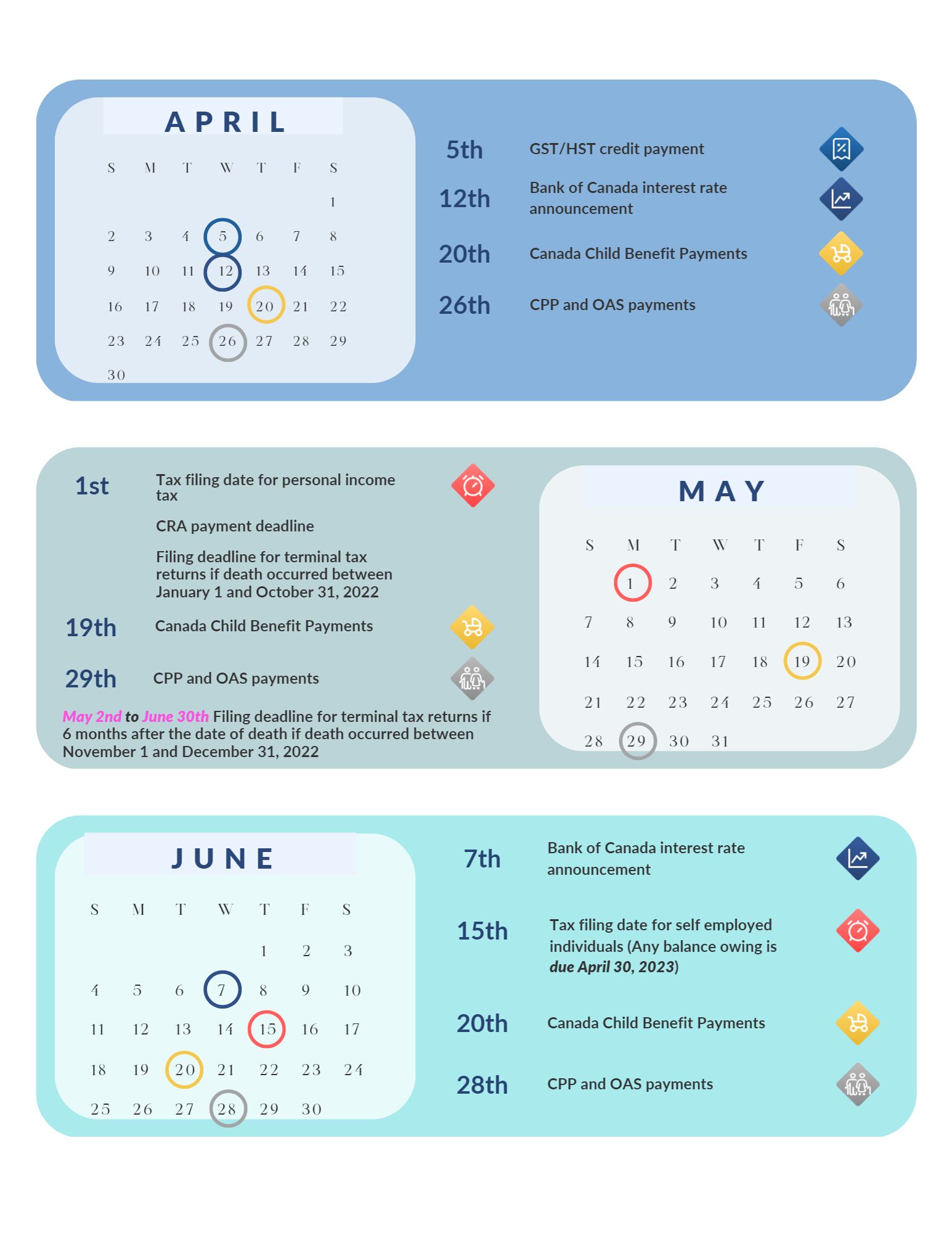
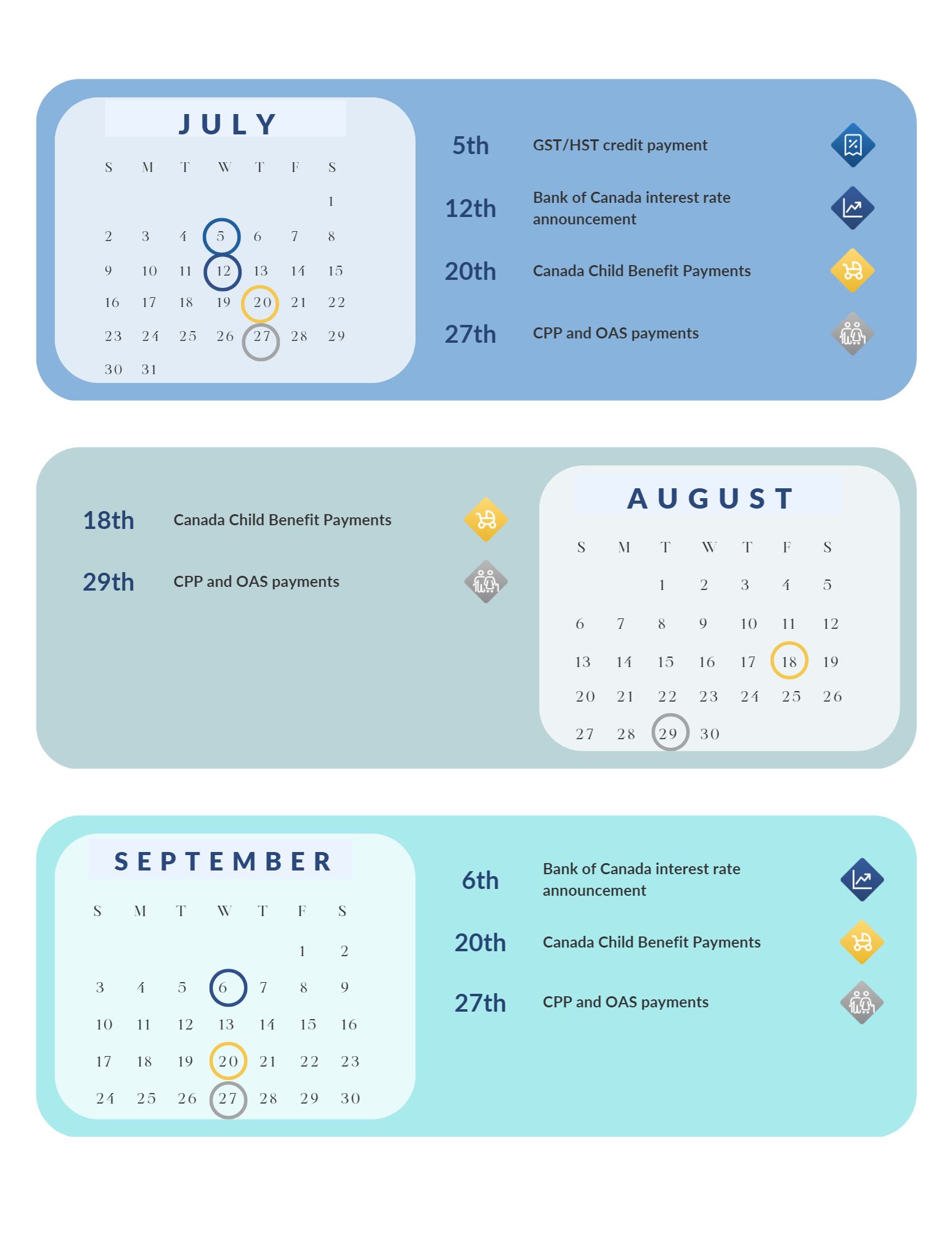
    TFSA versus RRSP – What you need to know to make the most of them in 2023

    February 2, 2023/in 2023, Blog, rrsp, Tax Free Savings Account/by LS Smith & Associates

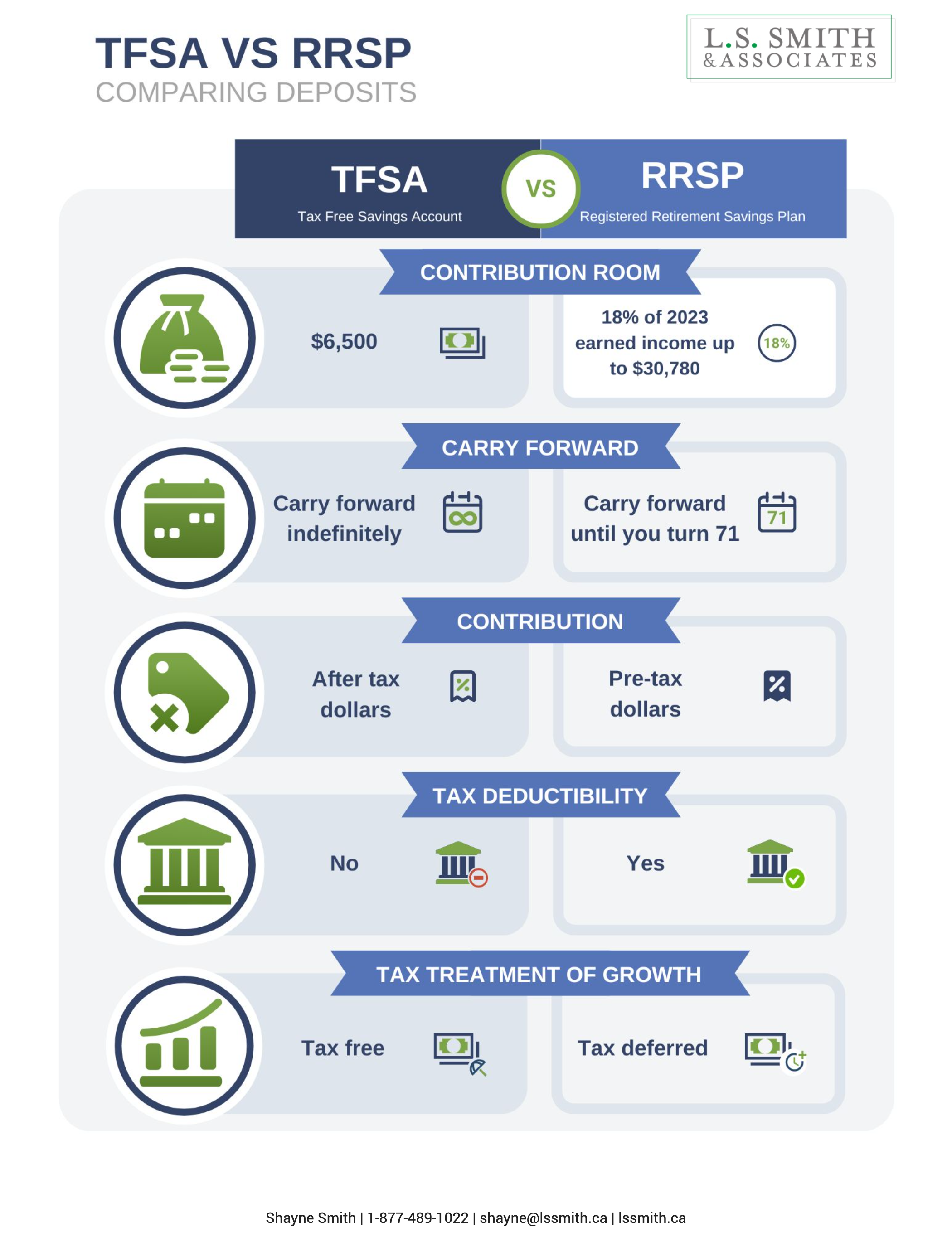
    When looking to save money in a tax-efficient manner, Tax-Free Savings Accounts (TFSA) and Registered Retirement Savings Plans (RRSP) can offer significant tax benefits. To assist you in understanding the distinctions, we will compare the following:

    • The differences in deposits between TFSAs and RRSPs

    • The differences in withdrawals between TFSAs and RRSPs

    TFSA versus RRSP – Difference in deposits

    When comparing deposit differences between TFSAs and RRSPs, there are several key considerations:

    • The amount of contribution room available

    • The ability to carry forward unused contributions

    • The tax deductibility of contributions

    • The tax treatment of growth in the account

    How much contribution room do I have?

    If you have never contributed to a TFSA, you can contribute up to $88,000 today. This table outlines the contribution amount you are allowed each year since TFSAs were created, including this year:

       
    Year   
       
    TFSA dollar limit   
       
    2023   
       
    $6,500   
       
    2022   
       
    $6,000   
       
    2021   
       
    $6,000   
       
    2020   
       
    $6,000   
       
    2019   
       
    $6,000   
       
    2018   
       
    $5,500   
       
    2017   
       
    $5,500   
       
    2016   
       
    $5,500   
       
    2015   
       
    $10,000   
       
    2014   
       
    $5,500   
       
    2013   
       
    $5,500   
       
    2012   
       
    $5,000   
       
    2011   
       
    $5,000   
       
    2010   
       
    $5,000   
       
    2009   
       
    $5,000   

    Regarding RRSPs, the limit for tax deductions is 18% of your pre-tax income from the previous year, with a maximum limit of $30,780. To illustrate, if your pre-tax income in 2022 was $60,000, your deduction limit for 2023 would be $10,800 (18% x $60,000). If your pre-tax income was $200,000, the maximum limit of $30,780 would apply.

    How much contribution room can I carry forward?

    Suppose you opt not to contribute to your TFSA each year or do not contribute the maximum amount. In that case, you can carry forward your unused contribution room indefinitely, provided you are a Canadian resident, over 18 years of age, and have a valid social insurance number. If you make a withdrawal, the amount withdrawn will be added to your annual contribution room for the next calendar year.

    In contrast, for an RRSP, you can carry forward your unused contribution room until age 71. Once you reach 71, you are required to convert your RRSP into an RRIF. Withdrawals from an RRSP do not create additional contribution room.

    The tax deductibility of contributions

    Your TFSA contributions are not tax-deductible and are made with after-tax dollars.

    Your RRSP contributions are tax-deductible and made with pre-tax dollars.

    Tax Treatment of Growth

    It is essential to contribute to both RRSP and TFSA because of the different tax treatment of the growth within them.

    A TFSA is ideal for short-term goals, such as saving for a down payment on a house or a vacation, as its growth is entirely tax-free. When withdrawing from your TFSA, you will not have to pay any income tax on the amount withdrawn. On the other hand, the growth within an RRSP is tax-deferred. This means you will not pay taxes on your RRSP gains until age 71, at which point you convert the RRSP into an RRIF and start withdrawing money.

    RRSPs are more suitable for long-term goals such as retirement because, in retirement, you will have a lower income and be in a lower tax bracket, resulting in less tax on your RRIF income.

    TFSA versus RRSP – Differences in withdrawals

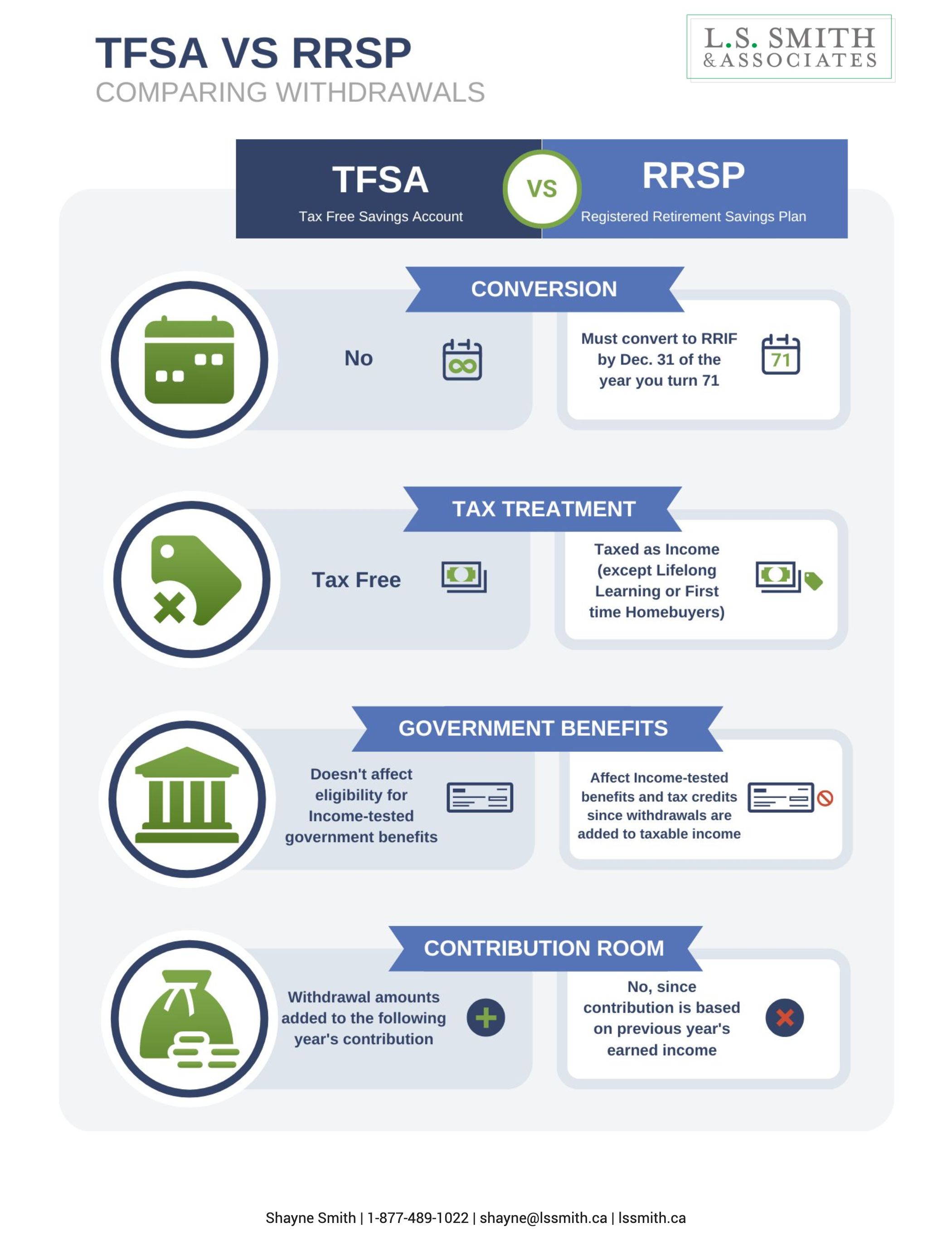
    There are several areas to focus on when comparing differences in withdrawal:

    • Conversion Requirements

    • Tax Treatment

    • Government Benefits

    • Contribution Room

    Conversion Requirements

    For a TFSA, there are never any conversion requirements as there is no maximum age for a TFSA.

    For an RRSP, you must convert it to a Registered Retirement Income Fund (RRIF) if you turn 71 by December 31st, 2023.

    Tax Treatment of Withdrawals

    One of the most attractive things about a TFSA is that all your withdrawals are tax-free! Therefore, they are recommended for short-term goals; you don’t have to worry about taxes when you take money out to pay for a house or a dream vacation.

    With an RRSP, if you make a withdrawal, it will be taxed as income except in two cases:

    • The Home Buyers Plan lets you withdraw up to $35,000 tax-free, but you must pay it back within fifteen years.

    • The Lifelong Learning Plan lets you withdraw up to $20,000 ($10,000 maximum per year) tax-free, but you must pay it back within ten years.

    How will my government benefits be impacted?

    If you are withdrawing from your TFSA or RRSP, it’s essential to know how that will affect any benefits you receive from the government.

    Since TFSA withdrawals are not considered taxable income, they will not impact your eligibility for income-tested government benefits.

    RRSP withdrawals are considered taxable income and can affect the following:

    • Income-tested tax credits such as Canada Child Tax Benefit, the Working Income Tax Benefit, the Goods and Services Tax Credit, and the Age Credit.

    • Government benefits, including Old Age Security, Guaranteed Income Supplement and Employment Insurance.

    How will a withdrawal impact my contribution room?

    If you withdraw from your TFSA, the amount you withdrew will be added on top of your annual contribution room for the following calendar year. If you withdraw from your RRSP, you do not open any additional contribution room.

    The Takeaway

    RRSPs and TFSAs can both be great savings vehicles. However, there are significant differences between them which can affect your finances. If you need help navigating these differences, please do not hesitate to contact us. We’re here to help.
    https://lssmith.ca/wp-content/uploads/2023/02/TFSA-or-RRSP-2023-Featured-Image-500px.jpeg 292 500 LS Smith & Associates https://lssmith.ca/wp-content/uploads/2018/05/lsSmithLogo.jpg LS Smith & Associates2023-02-02 17:13:002023-02-02 17:13:05TFSA versus RRSP – What you need to know to make the most of them in 2023
    Page 1 of 3123

    Book a Meeting

    Book a meeting

    Search Blog Posts

    Search Search

    Latest News

    • Tax Lines to Look Out For on Your 2025 Canadian Tax ReturnApril 1, 2026 - 12:02 pm
    • Manitoba Budget 2026March 30, 2026 - 8:53 am
    • 2026 Canada Money FactsMarch 2, 2026 - 12:17 pm

    Categories

    • 2019 Only
    • 2020
    • 2020 Only
    • 2021
    • 2022
    • 2022 Only
    • 2023
    • 2024
    • 2025
    • 2026
    • Accountants
    • Blog
    • business owners
    • Business Owners
    • buy sell
    • Charitable Gifting
    • Coronavirus
    • Coronavirus – Associates
    • Coronavirus – Practice Owners
    • Coronavirus – Retired
    • Coronavirus – Retiring
    • Coronavirus – Students
    • corporate
    • Critical Illness
    • critical illness insurance
    • Debt
    • dental benefits
    • disability
    • disability insurance
    • education
    • Estate Planning
    • Families
    • Family
    • financial advice
    • Financial Planning
    • Government Budget
    • Group Benefits
    • health benefits
    • incorporated professionals
    • individuals
    • Insurance
    • Investment
    • investments
    • life insurance
    • long term care
    • mortgage
    • pension plan
    • permanent insurance
    • personal finances
    • Professional Corporations
    • Professionals
    • rdsp
    • Registered Disability Savings Plan
    • Registered Education Savings Plan
    • RESP
    • Retirees
    • retirement
    • Retirement Savings
    • rrsp
    • Savings
    • tax
    • Tax Free Savings Account
    • term insurance
    • travel insurance

    Get in Touch

    L.S. Smith & Associates
    Shayne Smith
    Insurance and Financial Advisor
    Tel: (204) 489-1022
    Toll Free: 1-877-489-1022
    Email: Shayne@LSSmith.ca

    7-549 Regent Avenue West
    Winnipeg, MB
    R2C 1R9

    Latest News

    • Tax Lines to Look Out For on Your 2025 Canadian Tax ReturnApril 1, 2026 - 12:02 pm
    • Manitoba Budget 2026March 30, 2026 - 8:53 am
    • 2026 Canada Money FactsMarch 2, 2026 - 12:17 pm

    Newsletter

    About

    I believe that financial planning is about more than just a piece of good advice or investment returns. It’s all about providing the guidance that people can trust on.

    Liberty Tax Services

    ©2018 Financial Tech Tools Inc. | Privacy Statement and Terms of Use
      Scroll to top Scroll to top Scroll to top